Advertisements
Advertisements
प्रश्न
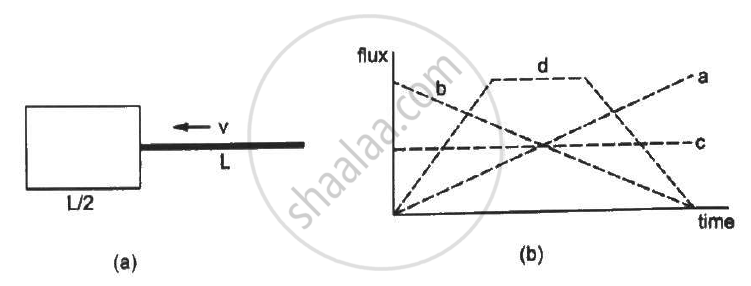
Following Figure (a) shows an imaginary cube of edge L/2. A uniformly charged rod of length (L) moves towards the left at a small but constant speed `nu.` At t = 0, the left end just touches the centre of the face of the cube opposite it. Which of the graphs shown in the figure (b) represents the flux of the electric field through the cube as the rod goes through it?
पर्याय
a
b
c
d
Advertisements
उत्तर
(d)
At first, when the rod is inserted into the cube, the flux start increasing. When the rod is fully inserted, the flux becomes constant and remains constant for the remaining L/2 length of the rod. After that, as the rod moves out of the cube, the flux starts decreasing. These processes are depicted only by curve (d).
APPEARS IN
संबंधित प्रश्न
Find out the outward flux to a point charge +q placed at the centre of a cube of side ‘a’. Why is it found to be independent of the size and shape of the surface enclosing it? Explain.
"The outward electric flux due to charge +Q is independent of the shape and size of the surface which encloses is." Give two reasons to justify this statement.
What is the electric flux through a cube of side 1 cm which encloses an electric dipole?
Given the electric field in the region `vecE=2xhati`, find the net electric flux through the cube and the charge enclosed by it.
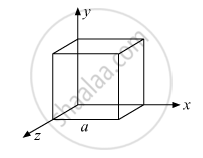
Given a uniform electric field \[\vec{E} = 2 \times {10}^3 \ \hat{i}\] N/C, find the flux of this field through a square of side 20 cm, whose plane is parallel to the y−z plane. What would be the flux through the same square, if the plane makes an angle of 30° with the x−axis ?
Two charges of magnitudes −3Q and + 2Q are located at points (a, 0) and (4a, 0) respectively. What is the electric flux due to these charges through a sphere of radius ‘5a’ with its centre at the origin?
It is said that any charge given to a conductor comes to its surface. Should all the protons come to the surface? Should all the electrons come to the surface? Should all the free electrons come to the surface?
If the flux associated with a coil changes at the rate of 360 webers every 4 minutes, then the induced e.m.f. is ______
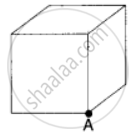
The total flux through the faces of the cube with side of length a if a charge q is placed at corner A of the cube is ______.
The SI unit of electric flux is ______.
A charge Qµc is placed at the centre of a cube the flux coming from any surface will be.
The electric charges are distributed in a small volume. The flux of the electric field through a spherical surface of radius 10 cm surrounding the total charge is 20 V-m. The flux over a concentric sphere of radius 20 cm will be ______.
A hollow cylinder has a charge of 'q' C within it. If 𝜙 is the electric flux associated with the curved surface B, the flux linked with the plane surface A will be ______.

An electric field is given by `(6 hat i + 5 hat j + 3 hat k)` N/C. The electric flux through a surface area `30 hat i` m2 lying in YZ-plane (in SI unit) is ______.
When the surface is parallel to the electric field lines, what is the resulting electric flux?
When the electric field direction is opposite to the area vector (θ = 180°), what is the flux?
What does negative electric flux indicate?
What is the key difference between the flux formula for an open surface and a closed surface?
