Advertisements
Advertisements
प्रश्न
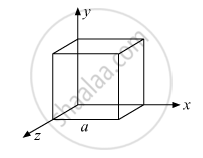
Given the electric field in the region `vecE=2xhati`, find the net electric flux through the cube and the charge enclosed by it.
Advertisements
उत्तर
Since the electric field has only x component, for faces normal to x direction, the angle between E and ∆S is ±π/2. Therefore, the flux is separately zero for each face of the cube except the two shaded ones.
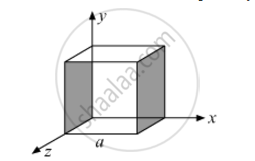
The magnitude of the electric field at the left face is EL = 0 (As x = 0 at the left face)
The magnitude of the electric field at the right face is ER = 2a (As x = a at the right face)
The corresponding fluxes are
`phi_L=vecE.DeltavecS=0`
`phi_R=vecE_R.DeltavecS=E_RDeltaScostheta=E_RDeltaS " "(.:theta=0^@)`
⇒ϕR= ERa2
Net flux (ϕ) through the cube = ϕL+ϕR=0+ERa2=ERa2
ϕ=2a(a)2=2a3
We can use Gauss’s law to find the total charge q inside the cube.
`phi=q/(epsilon_0)`
q=ϕε0=2a3ε0
APPEARS IN
संबंधित प्रश्न
Two charges of magnitudes +4Q and − Q are located at points (a, 0) and (− 3a, 0) respectively. What is the electric flux due to these charges through a sphere of radius ‘2a’ with its centre at the origin?
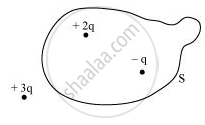
Figure shows three point charges +2q, −q and + 3q. Two charges + 2q and −q are enclosed within a surface ‘S’. What is the electric flux due to this configuration through the surface ‘S’?
Mark the correct options:
If the flux of the electric field through a closed surface is zero,
(a) the electric field must be zero everywhere on the surface
(b) the electric field may be zero everywhere on the surface
(c) the charge inside the surface must be zero
(d) the charge in the vicinity of the surface must be zero
If the flux associated with a coil changes at the rate of 360 webers every 4 minutes, then the induced e.m.f. is ______
In a region of space having a uniform electric field E, a hemispherical bowl of radius r is placed. The electric flux Φ through the bowl is:
A hollow sphere of radius R has a point charge Q at its centre. Electric flux emanating from it is `phi`. If both the charge and the radius of the sphere are doubled, electric flux emanating from the sphere will ______.
A hollow cylinder has a charge of 'q' C within it. If 𝜙 is the electric flux associated with the curved surface B, the flux linked with the plane surface A will be ______.

An electric field is given by `(6 hat i + 5 hat j + 3 hat k)` N/C. The electric flux through a surface area `30 hat i` m2 lying in YZ-plane (in SI unit) is ______.
When the surface is parallel to the electric field lines, what is the resulting electric flux?
