Advertisements
Advertisements
प्रश्न
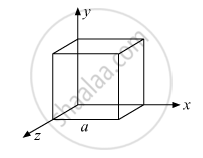
Given the electric field in the region `vecE=2xhati`, find the net electric flux through the cube and the charge enclosed by it.
Advertisements
उत्तर
Since the electric field has only x component, for faces normal to x direction, the angle between E and ∆S is ±π/2. Therefore, the flux is separately zero for each face of the cube except the two shaded ones.
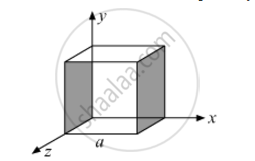
The magnitude of the electric field at the left face is EL = 0 (As x = 0 at the left face)
The magnitude of the electric field at the right face is ER = 2a (As x = a at the right face)
The corresponding fluxes are
`phi_L=vecE.DeltavecS=0`
`phi_R=vecE_R.DeltavecS=E_RDeltaScostheta=E_RDeltaS " "(.:theta=0^@)`
⇒ϕR= ERa2
Net flux (ϕ) through the cube = ϕL+ϕR=0+ERa2=ERa2
ϕ=2a(a)2=2a3
We can use Gauss’s law to find the total charge q inside the cube.
`phi=q/(epsilon_0)`
q=ϕε0=2a3ε0
APPEARS IN
संबंधित प्रश्न
Define electric flux.
What is the electric flux through a cube of side 1 cm which encloses an electric dipole?
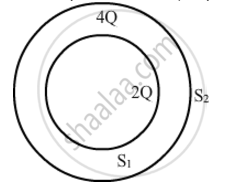
Consider two hollow concentric spheres, S1 and S2, enclosing charges 2Q and 4Q respectively as shown in the figure. (i) Find out the ratio of the electric flux through them. (ii) How will the electric flux through the sphere S1 change if a medium of dielectric constant 'εr' is introduced in the space inside S1 in place of air ? Deduce the necessary expression
Careful measurement of the electric field at the surface of a black box indicates that the net outward flux through the surface of the box is 8.0 × 10³ N m2/C.
- What is the net charge inside the box?
- If the net outward flux through the surface of the box were zero, could you conclude that there were no charges inside the box? Why or Why not?
If the flux associated with a coil changes at the rate of 360 webers every 4 minutes, then the induced e.m.f. is ______
A charged particle q is placed at the centre O of cube of length L (A B C D E F G H). Another same charge q is placed at a distance L from O. Then the electric flux through ABCD is ______.
An electric charge q is placed at the centre of a cube of side a. The electric flux on one of its faces will be ______.
A point charge q is placed at a distance a/2 directly above the centre of a square of side a. The electric flux through the square is ______.
