Advertisements
Advertisements
प्रश्न
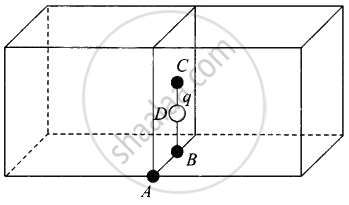
What will be the total flux through the faces of the cube (figure) with side of length a if a charge q is placed at

- A: a corner of the cube.
- B: mid-point of an edge of the cube.
- C: centre of a face of the cube.
- D: mid-point of B and C.
Advertisements
उत्तर
a. Use of symmetry consideration may be useful in problems of flux calculation. We can imagine the charged particle is placed at the centre of a cube of side 2a. We can observe that the charge is being shared equally by 8 cubes. Therefore, total flux through the faces of the given cube = `q/(8ε_0)`
 |
 |
| (A) | (B) |
b. If the charge q is placed at B, middle point of an edge of the cube, it is shared equally by 4 cubes. Therefore, total flux through the faces of the given cube = `q/(4ε_0)`

c. If the charge q is placed at C, the centre of a face of the cube, it is being shared equally by 2 cubes. Therefore, total flux through the faces of the given cube = `q/(2ε_0)`
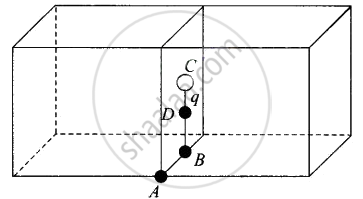
d. Finally, if charge q is placed at D, the mid-point of B and C, it is being shared equally by 2 cubes. Therefore, total flux through the faces of the
given cube = `q/(2ε_0)`
APPEARS IN
संबंधित प्रश्न
How does the electric flux due to a point charge enclosed by a spherical Gaussian surface get affected when its radius is increased?
Define electric flux.
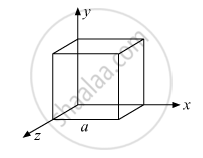
Given the electric field in the region `vecE=2xhati`, find the net electric flux through the cube and the charge enclosed by it.
Given a uniform electric filed \[\vec{E} = 4 \times {10}^3 \ \hat{i} N/C\]. Find the flux of this field through a square of 5 cm on a side whose plane is parallel to the Y-Z plane. What would be the flux through the same square if the plane makes a 30° angle with the x-axis?
A thin straight infinitely long conducting wire having charge density λ is enclosed by a cylindrical surface of radius r and length l, its axis coinciding with the length of the wire. Find the expression for the electric flux through the surface of the cylinder.
The electric field in a region is given by `vec"E"` = 5 `hatk`N/C. Calculate the electric flux Through a square of side 10.0 cm in the following cases
- The square is along the XY plane
- The square is along XZ plane
- The normal to the square makes an angle of 45° with the Z axis.
A charge 'Q' µC is placed at the centre of a cube. The flux through one face and two opposite faces of the cube is respectively ______.
Total electric flux coming out of a unit positive charge kept in air is ______.
If the electric flux entering and leaving an enclosed surface respectively is Φ1 and Φ2, the electric charge inside the surface will be
In a region of space having a uniform electric field E, a hemispherical bowl of radius r is placed. The electric flux Φ through the bowl is:
An electric charge q is placed at the center of a cube of side ℓ. The electric flux on one of its faces will be ______.
The S.I. unit of electric flux is ______
An electric field is given by `(6 hat i + 5 hat j + 3 hat k)` N/C. The electric flux through a surface area `30 hat i` m2 lying in YZ-plane (in SI unit) is ______.
Electric flux through a surface is defined as which of the following?
The formula for electric flux when the electric field is uniform is expressed as which of the following?
According to the rain analogy for electric flux, what determines how much rain (field) passes through a tilted sheet of cardboard?
