Advertisements
Advertisements
प्रश्न
Consider a uniform electric field E = 3 × 10³ `hat i` N/C.
- What is the flux of this field through a square of 10 cm on a side whose plane is parallel to the yz plane?
- What is the flux through the same square if the normal to its plane makes a 60° angle with the x-axis?
Advertisements
उत्तर
(a) Area of square, A = a2 = 102 = 100 cm2
= 100 × 10-4 m2
= 10−2 m2
Since the plane lies on the y-z-axis, the area vector `vecA` points in the same direction.
i.e., `vecA = (10^-2 hati) m^2`
∴ Electric Flux through the square is:
Φ = `vecE · vecA` = `(3 xx 10^3 hati)*(10^-2 hati)`
= 3 × 101
or Φ = 30 V-m
(b) When normal to plane, i.e., `vecA` makes an angle of 60° with `vecE`, then
Φ' = EA cos 60°
= `3 xx 10^3 xx 10^-2 xx 1/2`
= 1.5 × 101
or Φ' = 15 V-m
संबंधित प्रश्न
Define electric flux.
Write S.I unit of electric flux.
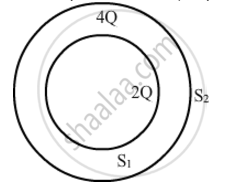
Consider two hollow concentric spheres, S1 and S2, enclosing charges 2Q and 4Q respectively as shown in the figure. (i) Find out the ratio of the electric flux through them. (ii) How will the electric flux through the sphere S1 change if a medium of dielectric constant 'εr' is introduced in the space inside S1 in place of air ? Deduce the necessary expression
Two charges of magnitudes −2Q and +Q are located at points (a, 0) and (4a, 0) respectively. What is the electric flux due to these charges through a sphere of radius ‘3a’ with its centre at the origin?
A cylinder of radius R and length L is placed in a uniform electric field E parallel to the cylinder axis. The total flux for the surface of the cylinder is given by ______.
Total electric flux coming out of a unit positive charge kept in air is ______.
If the electric flux entering and leaving an enclosed surface respectively is Φ1 and Φ2, the electric charge inside the surface will be
An electric charge q is placed at the center of a cube of side ℓ. The electric flux on one of its faces will be ______.
What will be the total flux through the faces of the cube (figure) with side of length a if a charge q is placed at

- A: a corner of the cube.
- B: mid-point of an edge of the cube.
- C: centre of a face of the cube.
- D: mid-point of B and C.
For a general surface, electric flux is calculated using which integral expression?
The formula for electric flux when the electric field is uniform is expressed as which of the following?
What is the SI unit of electric flux?
According to the rain analogy for electric flux, what determines how much rain (field) passes through a tilted sheet of cardboard?
For an open surface, which statement correctly describes the area vector convention?
For a closed surface, which convention must be followed when assigning the area vector?
What does positive electric flux indicate?
