Advertisements
Advertisements
Question
Consider a uniform electric field E = 3 × 10³ `hat i` N/C.
- What is the flux of this field through a square of 10 cm on a side whose plane is parallel to the yz plane?
- What is the flux through the same square if the normal to its plane makes a 60° angle with the x-axis?
Advertisements
Solution
(a) Area of square, A = a2 = 102 = 100 cm2
= 100 × 10-4 m2
= 10−2 m2
Since the plane lies on the y-z-axis, the area vector `vecA` points in the same direction.
i.e., `vecA = (10^-2 hati) m^2`
∴ Electric Flux through the square is:
Φ = `vecE · vecA` = `(3 xx 10^3 hati)*(10^-2 hati)`
= 3 × 101
or Φ = 30 V-m
(b) When normal to plane, i.e., `vecA` makes an angle of 60° with `vecE`, then
Φ' = EA cos 60°
= `3 xx 10^3 xx 10^-2 xx 1/2`
= 1.5 × 101
or Φ' = 15 V-m
RELATED QUESTIONS
Define electric flux.
What is the electric flux through a cube of side 1 cm which encloses an electric dipole?
Careful measurement of the electric field at the surface of a black box indicates that the net outward flux through the surface of the box is 8.0 × 10³ N m2/C.
- What is the net charge inside the box?
- If the net outward flux through the surface of the box were zero, could you conclude that there were no charges inside the box? Why or Why not?
Two charges of magnitudes −3Q and + 2Q are located at points (a, 0) and (4a, 0) respectively. What is the electric flux due to these charges through a sphere of radius ‘5a’ with its centre at the origin?
Two charges of magnitudes +4Q and − Q are located at points (a, 0) and (− 3a, 0) respectively. What is the electric flux due to these charges through a sphere of radius ‘2a’ with its centre at the origin?
A charge q is placed at the centre of the open end of a cylindrical vessel (see the figure). The flux of the electric field through the surface of the vessel is ____________ .
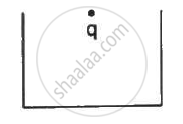
The electric flux through a closed Gaussian surface depends upon ______.
The total flux through the faces of the cube with side of length a if a charge q is placed at corner A of the cube is ______.
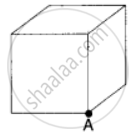
The S.I. unit of electric flux is ______
A circular disc of radius 'r' is placed along the plane of paper. A uniform electric field `vec"E"` is also present in the plane of paper. What amount of electric flux is associated with it?

What will be the total flux through the faces of the cube (figure) with side of length a if a charge q is placed at

- A: a corner of the cube.
- B: mid-point of an edge of the cube.
- C: centre of a face of the cube.
- D: mid-point of B and C.
Electric flux through a surface is defined as which of the following?
The formula for electric flux when the electric field is uniform is expressed as which of the following?
According to the rain analogy for electric flux, what determines how much rain (field) passes through a tilted sheet of cardboard?
For an open surface, which statement correctly describes the area vector convention?
For a closed surface, which convention must be followed when assigning the area vector?
For a surface inclined at an angle such that 0° < θ < 90°, which statement correctly describes the flux?
