Advertisements
Advertisements
Question
A circular ring of radius r made of a non-conducting material is placed with its axis parallel to a uniform electric field. The ring is rotated about a diameter through 180°. Does the flux of the electric field change? If yes, does it decrease or increase?
Advertisements
Solution
It is given that the circular ring, made of a non-conducting material, of radius r is placed with its axis parallel to a uniform electric field.This means that both the electric field and the area vector are parallel to each other (area vector is always perpendicular to the surface area). Thus, the flux through the ring is given by `vec"E" . vec"S"` = ES cos 0 = `"E"(pi"r"^2).`
Now, when the ring is rotated about its diameter through 1800, the angle between the area vector and the electric field becomes 1800. Thus, the flux becomes - `"E"(pi"r"^2)` .
APPEARS IN
RELATED QUESTIONS
What is the net flux of the uniform electric field of previous question through a cube of side 20 cm oriented so that its faces are parallel to the coordinate planes?
Careful measurement of the electric field at the surface of a black box indicates that the net outward flux through the surface of the box is 8.0 × 10³ N m2/C.
- What is the net charge inside the box?
- If the net outward flux through the surface of the box were zero, could you conclude that there were no charges inside the box? Why or Why not?
Two charges of magnitudes +4Q and − Q are located at points (a, 0) and (− 3a, 0) respectively. What is the electric flux due to these charges through a sphere of radius ‘2a’ with its centre at the origin?
Mark the correct options:
If the flux of the electric field through a closed surface is zero,
(a) the electric field must be zero everywhere on the surface
(b) the electric field may be zero everywhere on the surface
(c) the charge inside the surface must be zero
(d) the charge in the vicinity of the surface must be zero
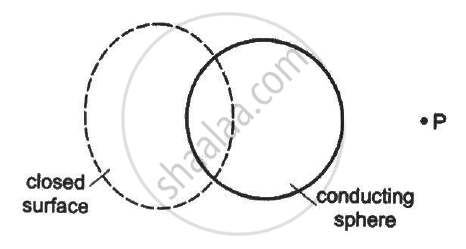
The following figure shows a closed surface that intersects a conducting sphere. If a positive charge is placed at point P, the flux of the electric field through the closed surface
If the flux associated with a coil changes at the rate of 360 webers every 4 minutes, then the induced e.m.f. is ______
A charge 'Q' µC is placed at the centre of a cube. The flux through one face and two opposite faces of the cube is respectively ______.
Total electric flux coming out of a unit positive charge kept in air is ______.
A charge Qµc is placed at the centre of a cube the flux coming from any surface will be.
An electric charge q is placed at the center of a cube of side ℓ. The electric flux on one of its faces will be ______.
The electric charges are distributed in a small volume. The flux of the electric field through a spherical surface of radius 10 cm surrounding the total charge is 20 V-m. The flux over a concentric sphere of radius 20 cm will be ______.
A hollow sphere of radius R has a point charge q at its centre. Electric flux emanating from the sphere is X. How will the electric flux change, if at all, when charge q is replaced by an electric dipole?
What is the dimensional formula for electric flux?
According to the rain analogy for electric flux, what determines how much rain (field) passes through a tilted sheet of cardboard?
For a closed surface, which convention must be followed when assigning the area vector?
What does positive electric flux indicate?
What does negative electric flux indicate?
Electric flux is a scalar quantity, but its value can be positive, negative, or zero. What does this depend on?
