Advertisements
Advertisements
Question
A small plane area is rotated in an electric field. In which orientation of the area, is the flux of the electric field through the area maximum? In which orientation is it zero?
Advertisements
Solution
The flux of an electric field `vec"E"` through a surface area `triangle vec"S"` is given by Δ Ø = `vec"E" . triangle vec"S" `, where ΔØ is the flux . Therefore , ΔØ= E Δ S Cos θ .
Here , θ is the angle between the electric field `vec"E" ` and the normal to the surface area.
Thus, for the flux to be maximum, cos θ should be maximum. Thus, for θ = 0, the flux is maximum, i.e. the electric field lines are perpendicular to the surface area.
The flux is minimum if θ = 90. Thus, cos θ = 0 and, hence, flux is also 0. Thus, if the electric field lines are parallel to the surface area, the flux is minimum.
APPEARS IN
RELATED QUESTIONS
Define electric flux.
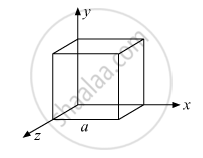
Given the electric field in the region `vecE=2xhati`, find the net electric flux through the cube and the charge enclosed by it.
Two charges of magnitudes +4Q and − Q are located at points (a, 0) and (− 3a, 0) respectively. What is the electric flux due to these charges through a sphere of radius ‘2a’ with its centre at the origin?
A circular ring of radius r made of a non-conducting material is placed with its axis parallel to a uniform electric field. The ring is rotated about a diameter through 180°. Does the flux of the electric field change? If yes, does it decrease or increase?
If the flux associated with a coil changes at the rate of 360 webers every 4 minutes, then the induced e.m.f. is ______
A uniform electric field of intensity 400 N/C, exists in a certain region. How much flux will cross a given area of 10 cm2 in this region, if the area vector is inclined at 60° to the direction of the field?
Total electric flux coming out of a unit positive charge kept in air is ______.
In a region of space having a uniform electric field E, a hemispherical bowl of radius r is placed. The electric flux Φ through the bowl is:
A charge Qµc is placed at the centre of a cube the flux coming from any surface will be.
The S.I. unit of electric flux is ______
A circular disc of radius 'r' is placed along the plane of paper. A uniform electric field `vec"E"` is also present in the plane of paper. What amount of electric flux is associated with it?

A hollow sphere of radius R has a point charge q at its centre. Electric flux emanating from the sphere is X. How will the electric flux change, if at all, when radius of the sphere is doubled?
An electric field is given by `(6 hat i + 5 hat j + 3 hat k)` N/C. The electric flux through a surface area `30 hat i` m2 lying in YZ-plane (in SI unit) is ______.
In the electric flux formula \[\Phi = EA \cos \theta\], what does θ represent?
What is the SI unit of electric flux?
For an open surface, which statement correctly describes the area vector convention?
When the electric field direction is opposite to the area vector (θ = 180°), what is the flux?
What is the key difference between the flux formula for an open surface and a closed surface?
