Advertisements
Advertisements
प्रश्न
Mark the correct options:
विकल्प
Gauss's Law is valid only for symmetrical charge distributions.
Gauss's Law is valid only for charges placed in vacuum.
The electric field calculated by Gauss's Law is the field due to the charge inside the Gaussian surface.
The flux of the electric field through a closed surface due to all the charges is equal to the flux due to the charges enclosed by the surface.
Advertisements
उत्तर
The flux of the electric field through a closed surface due to all the charges is equal to the flux due to the charges enclosed by the surface.
The contribution of flux on the closed surface due to the charges lying outside the surface is zero because number of field line entering the closed surface is equal to the number of field lines coming out of the surface so the net contribution of the charge lying outside the closed surface to the flux is zero. Therefore, the net flux through the surface due to the charge lying outside the the closed surface is zero. The contribution that counts is only due to the charges lying within the closed surface.
Thus, the flux of the electric field through a closed surface due to all the charges (inside and outside the surface) is equal to the flux due to the charges enclosed by the surface
APPEARS IN
संबंधित प्रश्न
What is the electric flux through a cube of side 1 cm which encloses an electric dipole?
Careful measurement of the electric field at the surface of a black box indicates that the net outward flux through the surface of the box is 8.0 × 10³ N m2/C.
- What is the net charge inside the box?
- If the net outward flux through the surface of the box were zero, could you conclude that there were no charges inside the box? Why or Why not?
A uniformly charged conducting sphere of 2.4 m diameter has a surface charge density of 80.0 μC/m2.
- Find the charge on the sphere.
- What is the total electric flux leaving the surface of the sphere?
Given a uniform electric filed \[\vec{E} = 4 \times {10}^3 \ \hat{i} N/C\]. Find the flux of this field through a square of 5 cm on a side whose plane is parallel to the Y-Z plane. What would be the flux through the same square if the plane makes a 30° angle with the x-axis?
Two charges of magnitudes −2Q and +Q are located at points (a, 0) and (4a, 0) respectively. What is the electric flux due to these charges through a sphere of radius ‘3a’ with its centre at the origin?
It is said that any charge given to a conductor comes to its surface. Should all the protons come to the surface? Should all the electrons come to the surface? Should all the free electrons come to the surface?
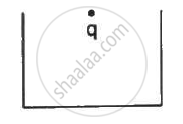
A charge q is placed at the centre of the open end of a cylindrical vessel (see the figure). The flux of the electric field through the surface of the vessel is ____________ .
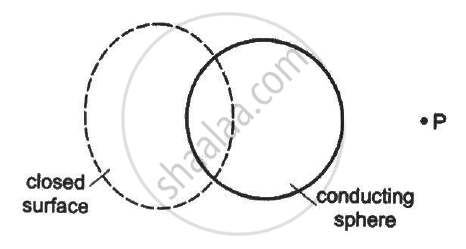
The following figure shows a closed surface that intersects a conducting sphere. If a positive charge is placed at point P, the flux of the electric field through the closed surface
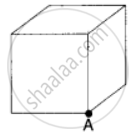
The total flux through the faces of the cube with side of length a if a charge q is placed at corner A of the cube is ______.
The SI unit of electric flux is ______.
The electric field in a region is given by `bar"E" = 4hat"i" + 10hat"j"` N/C. The flux of this field through a square of 10 cm on a side whose plane is parallel to the XZ plane.
A charge Qµc is placed at the centre of a cube the flux coming from any surface will be.
An electric field is given by `(6 hat i + 5 hat j + 3 hat k)` N/C. The electric flux through a surface area `30 hat i` m2 lying in YZ-plane (in SI unit) is ______.
The formula for electric flux when the electric field is uniform is expressed as which of the following?
What is the dimensional formula for electric flux?
For an open surface, which statement correctly describes the area vector convention?
For a surface inclined at an angle such that 0° < θ < 90°, which statement correctly describes the flux?
What does positive electric flux indicate?
