Advertisements
Advertisements
प्रश्न
Mark the correct options:
पर्याय
Gauss's Law is valid only for symmetrical charge distributions.
Gauss's Law is valid only for charges placed in vacuum.
The electric field calculated by Gauss's Law is the field due to the charge inside the Gaussian surface.
The flux of the electric field through a closed surface due to all the charges is equal to the flux due to the charges enclosed by the surface.
Advertisements
उत्तर
The flux of the electric field through a closed surface due to all the charges is equal to the flux due to the charges enclosed by the surface.
The contribution of flux on the closed surface due to the charges lying outside the surface is zero because number of field line entering the closed surface is equal to the number of field lines coming out of the surface so the net contribution of the charge lying outside the closed surface to the flux is zero. Therefore, the net flux through the surface due to the charge lying outside the the closed surface is zero. The contribution that counts is only due to the charges lying within the closed surface.
Thus, the flux of the electric field through a closed surface due to all the charges (inside and outside the surface) is equal to the flux due to the charges enclosed by the surface
APPEARS IN
संबंधित प्रश्न
Given the electric field in the region `vecE=2xhati`, find the net electric flux through the cube and the charge enclosed by it.
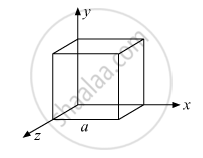
What is the net flux of the uniform electric field of previous question through a cube of side 20 cm oriented so that its faces are parallel to the coordinate planes?
Careful measurement of the electric field at the surface of a black box indicates that the net outward flux through the surface of the box is 8.0 × 10³ N m2/C.
- What is the net charge inside the box?
- If the net outward flux through the surface of the box were zero, could you conclude that there were no charges inside the box? Why or Why not?
A uniformly charged conducting sphere of 2.4 m diameter has a surface charge density of 80.0 μC/m2.
- Find the charge on the sphere.
- What is the total electric flux leaving the surface of the sphere?
A circular ring of radius r made of a non-conducting material is placed with its axis parallel to a uniform electric field. The ring is rotated about a diameter through 180°. Does the flux of the electric field change? If yes, does it decrease or increase?
If the flux of the electric field through a closed surface is zero,
(a) the electric field must be zero everywhere on the surface
(b) the electric field may be zero everywhere on the surface
(c) the charge inside the surface must be zero
(d) the charge in the vicinity of the surface must be zero
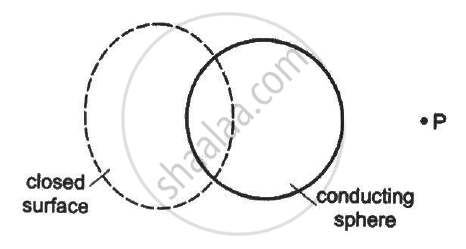
The following figure shows a closed surface that intersects a conducting sphere. If a positive charge is placed at point P, the flux of the electric field through the closed surface
A charged particle q is placed at the centre O of cube of length L (A B C D E F G H). Another same charge q is placed at a distance L from O. Then the electric flux through ABCD is ______.
A cylinder of radius R and length L is placed in a uniform electric field E parallel to the cylinder axis. The total flux for the surface of the cylinder is given by ______.
An electric charge q is placed at the centre of a cube of side a. The electric flux on one of its faces will be ______.
The electric field in a region is given by `bar"E" = 4hat"i" + 10hat"j"` N/C. The flux of this field through a square of 10 cm on a side whose plane is parallel to the XZ plane.
A circular disc of radius 'r' is placed along the plane of paper. A uniform electric field `vec"E"` is also present in the plane of paper. What amount of electric flux is associated with it?

A hollow sphere of radius R has a point charge q at its centre. Electric flux emanating from the sphere is X. How will the electric flux change, if at all, when radius of the sphere is doubled?
For a general surface, electric flux is calculated using which integral expression?
In the electric flux formula \[\Phi = EA \cos \theta\], what does θ represent?
For an open surface, which statement correctly describes the area vector convention?
When the surface is parallel to the electric field lines, what is the resulting electric flux?
When the electric field direction is opposite to the area vector (θ = 180°), what is the flux?
What is the key difference between the flux formula for an open surface and a closed surface?
