Advertisements
Advertisements
प्रश्न
Define electric flux.
Define electric flux. Is it a scalar or a vector quantity?
Advertisements
उत्तर १
Electric flux is the total number of lines of force passing through the unit area of a surface held perpendicularly.
Electric flux ΔΦ through an area element ΔS is given by
ΔΦ = E.ΔS = EΔScosθ
θ is the angle between E and ΔS.
उत्तर २
Electric flux is defined as the number of electric field lines crossing the per unit area. It is given as
`triangle phi = vecE.vec(triangleS) cos theta`
where `vecE` is Electric field and `vec(triangleS)`is area vector. The angle θ here is the angle between `vecE` and `vec(triangle S)`.
Since Electric flux is the dot product of two vectors, Hence it is a Scalar quantity.
APPEARS IN
संबंधित प्रश्न
How does the electric flux due to a point charge enclosed by a spherical Gaussian surface get affected when its radius is increased?
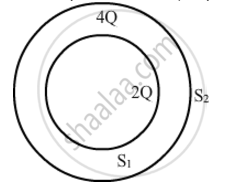
Consider two hollow concentric spheres, S1 and S2, enclosing charges 2Q and 4Q respectively as shown in the figure. (i) Find out the ratio of the electric flux through them. (ii) How will the electric flux through the sphere S1 change if a medium of dielectric constant 'εr' is introduced in the space inside S1 in place of air ? Deduce the necessary expression
Given a uniform electric filed \[\vec{E} = 4 \times {10}^3 \ \hat{i} N/C\]. Find the flux of this field through a square of 5 cm on a side whose plane is parallel to the Y-Z plane. What would be the flux through the same square if the plane makes a 30° angle with the x-axis?
It is said that any charge given to a conductor comes to its surface. Should all the protons come to the surface? Should all the electrons come to the surface? Should all the free electrons come to the surface?
Following Figure (a) shows an imaginary cube of edge L/2. A uniformly charged rod of length (L) moves towards the left at a small but constant speed `nu.` At t = 0, the left end just touches the centre of the face of the cube opposite it. Which of the graphs shown in the figure (b) represents the flux of the electric field through the cube as the rod goes through it?
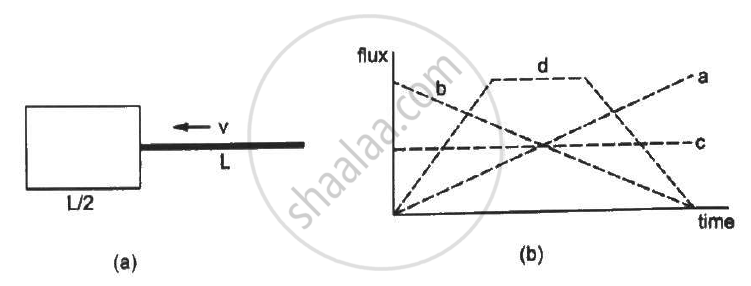
Mark the correct options:
The electric field intensity due to an infinite cylinder of radius R and having charge q per unit length at a distance rir r(r > R) from its axis is ______.
When the electric field is parallel to the surface, what is the angle θ between the field vector and the area vector?
What does positive electric flux indicate?
What is the key difference between the flux formula for an open surface and a closed surface?
