Advertisements
Advertisements
Question
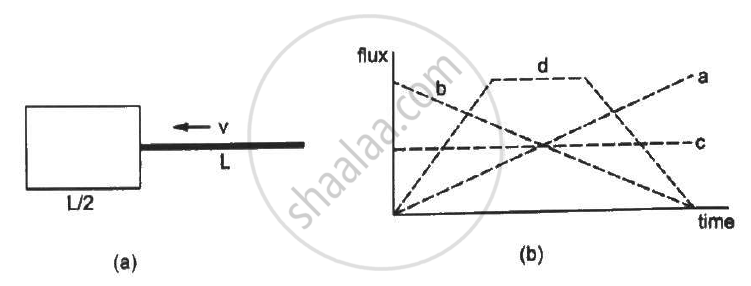
Following Figure (a) shows an imaginary cube of edge L/2. A uniformly charged rod of length (L) moves towards the left at a small but constant speed `nu.` At t = 0, the left end just touches the centre of the face of the cube opposite it. Which of the graphs shown in the figure (b) represents the flux of the electric field through the cube as the rod goes through it?
Options
a
b
c
d
Advertisements
Solution
(d)
At first, when the rod is inserted into the cube, the flux start increasing. When the rod is fully inserted, the flux becomes constant and remains constant for the remaining L/2 length of the rod. After that, as the rod moves out of the cube, the flux starts decreasing. These processes are depicted only by curve (d).
APPEARS IN
RELATED QUESTIONS
How does the electric flux due to a point charge enclosed by a spherical Gaussian surface get affected when its radius is increased?
Define electric flux.
What is the net flux of the uniform electric field of previous question through a cube of side 20 cm oriented so that its faces are parallel to the coordinate planes?
Careful measurement of the electric field at the surface of a black box indicates that the net outward flux through the surface of the box is 8.0 × 10³ N m2/C.
- What is the net charge inside the box?
- If the net outward flux through the surface of the box were zero, could you conclude that there were no charges inside the box? Why or Why not?
A uniformly charged conducting sphere of 2.4 m diameter has a surface charge density of 80.0 μC/m2.
- Find the charge on the sphere.
- What is the total electric flux leaving the surface of the sphere?
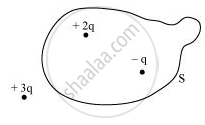
Figure shows three point charges +2q, −q and + 3q. Two charges + 2q and −q are enclosed within a surface ‘S’. What is the electric flux due to this configuration through the surface ‘S’?
It is said that any charge given to a conductor comes to its surface. Should all the protons come to the surface? Should all the electrons come to the surface? Should all the free electrons come to the surface?
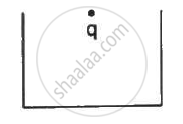
A charge q is placed at the centre of the open end of a cylindrical vessel (see the figure). The flux of the electric field through the surface of the vessel is ____________ .
Mark the correct options:
If the flux of the electric field through a closed surface is zero,
(a) the electric field must be zero everywhere on the surface
(b) the electric field may be zero everywhere on the surface
(c) the charge inside the surface must be zero
(d) the charge in the vicinity of the surface must be zero
A uniform electric field of intensity 400 N/C, exists in a certain region. How much flux will cross a given area of 10 cm2 in this region, if the area vector is inclined at 60° to the direction of the field?
The SI unit of electric flux is ______.
An electric charge q is placed at the centre of a cube of side a. The electric flux on one of its faces will be ______.
A charge Qµc is placed at the centre of a cube the flux coming from any surface will be.
A hollow sphere of radius R has a point charge Q at its centre. Electric flux emanating from it is `phi`. If both the charge and the radius of the sphere are doubled, electric flux emanating from the sphere will ______.
A hollow sphere of radius R has a point charge q at its centre. Electric flux emanating from the sphere is X. How will the electric flux change, if at all, when radius of the sphere is doubled?
A hollow cylinder has a charge of 'q' C within it. If 𝜙 is the electric flux associated with the curved surface B, the flux linked with the plane surface A will be ______.

According to the rain analogy for electric flux, what determines how much rain (field) passes through a tilted sheet of cardboard?
When the surface is parallel to the electric field lines, what is the resulting electric flux?
What does positive electric flux indicate?
