Advertisements
Advertisements
प्रश्न
If there were only one type of charge in the universe, then ______.
- `oint_s` E.dS ≠ 0 on any surface.
- `oint_s` E.dS = 0 if the charge is outside the surface.
- `oint_s` E.dS could not be defined.
- `oint_s` E.dS = `q/ε_0` if charges of magnitude q were inside the surface.
विकल्प
a and d
a and c
b and d
c and d
Advertisements
उत्तर
b and d
Explanation:
From Gauss’ law, we know `oint_s` E.dS = `q/ε_0`, here q is the charge enclosed by the closed surface. If `oint_s` E.dS = 0 then q = 0, i.e., net charge enclosed by the surface must be zero. If the charge is outside the surface, then charge enclosed by the surface is q = 0 and thus, `oint` E.dS = 0.
APPEARS IN
संबंधित प्रश्न
A thin conducting spherical shell of radius R has charge Q spread uniformly over its surface. Using Gauss’s law, derive an expression for an electric field at a point outside the shell.
State Gauss’s law on electrostatics and drive expression for the electric field due to a long straight thin uniformly charged wire (linear charge density λ) at a point lying at a distance r from the wire.
Gaussian surface cannot pass through discrete charge because ____________.
q1, q2, q3 and q4 are point charges located at points as shown in the figure and S is a spherical gaussian surface of radius R. Which of the following is true according to the Gauss' law?

The surface considered for Gauss’s law is called ______.
Five charges q1, q2, q3, q4, and q5 are fixed at their positions as shown in figure. S is a Gaussian surface. The Gauss’s law is given by `oint_s E.ds = q/ε_0`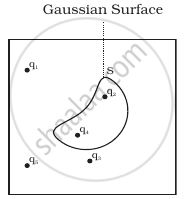
Which of the following statements is correct?
Consider a region inside which there are various types of charges but the total charge is zero. At points outside the region
- the electric field is necessarily zero.
- the electric field is due to the dipole moment of the charge distribution only.
- the dominant electric field is `∞ 1/r^3`, for large r, where r is the distance from a origin in this region.
- the work done to move a charged particle along a closed path, away from the region, will be zero.
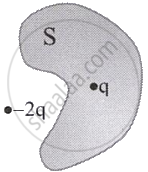
In the diagram, the total electric flux through the closed surface ‘S’ is:
[Given q = charge ε0 = permittivity of free space]
A charge of +5 μC is placed at the centre of two concentric spheres of radii r1 = 3 cm and r2 = 5 cm. The ratio of the flux through sphere of radius r1 to that through sphere of radius r2 will be ______.
For a Gaussian surface to be convenient for calculations, the electric field should be:
According to Gauss's Law, the total electric flux through a closed surface depends on:
The algebraic form of Gauss's Law is represented as:
The integral form of Gauss's Law is given by:
What is the SI unit of permittivity of free space (ε₀)?
For an infinite line charge with linear charge density λ, the electric field at distance r from the wire is:
The electric field due to a uniformly charged infinite plane sheet with surface charge density σ is:
For a uniformly charged thin spherical shell, what is the electric field at any point inside the shell (r < R)?
In a non-uniform electric field given by \[\vec{E} = \alpha x^{1/2} \hat{i}\] with \[\alpha = 800 \text{ N C}^{-1}\text{m}^{-1/2}\], the flux through a cube of side a = 0.1 m oriented with faces perpendicular to the x-axis is approximately:
