Advertisements
Advertisements
प्रश्न
Five charges q1, q2, q3, q4, and q5 are fixed at their positions as shown in figure. S is a Gaussian surface. The Gauss’s law is given by `oint_s E.ds = q/ε_0`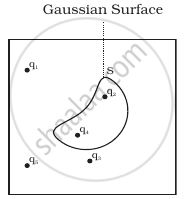
Which of the following statements is correct?
विकल्प
E on the LHS of the above equation will have a contribution from q1, q5 and q3 while q on the RHS will have a contribution from q2 and q4 only.
E on the LHS of the above equation will have a contribution from all charges while q on the RHS will have a contribution from q2 and q4 only.
E on the LHS of the above equation will have a contribution from all charges while q on the RHS will have a contribution from q1, q3 and q5 only.
Both E on the LHS and q on the RHS will have contributions from q2 and q4 only.
Advertisements
उत्तर
E on the LHS of the above equation will have a contribution from all charges while q on the RHS will have a contribution from q2 and q4 only.
Explanation:
According to Gauss’ law, the term `q_(enclosed)` on the right side of the equation `oint_s E.ds = q_(enclosed)/ε_0` includes the sum of all charges enclosed by the surface called (Gaussian surface). In left side equation, the electric field is due to all the charges present both inside as well as outside the Gaussian surface.
APPEARS IN
संबंधित प्रश्न
State and explain Gauss’s law.
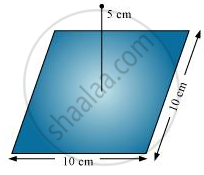
A point charge +10 μC is a distance 5 cm directly above the centre of a square of side 10 cm, as shown in the Figure. What is the magnitude of the electric flux through the square? (Hint: Think of the square as one face of a cube with edge 10 cm.)
A charge ‘q’ is placed at the centre of a cube of side l. What is the electric flux passing through each face of the cube?
The surface considered for Gauss’s law is called ______.
Which of the following statements is not true about Gauss’s law?
The Electric flux through the surface
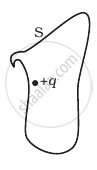 (i) |
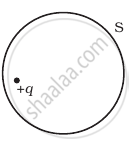 (ii) |
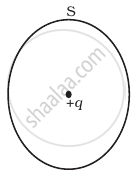 (iii) |
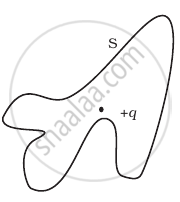 (iv) |
If there were only one type of charge in the universe, then ______.
- `oint_s` E.dS ≠ 0 on any surface.
- `oint_s` E.dS = 0 if the charge is outside the surface.
- `oint_s` E.dS could not be defined.
- `oint_s` E.dS = `q/ε_0` if charges of magnitude q were inside the surface.
The region between two concentric spheres of radii a < b contain volume charge density ρ(r) = `"c"/"r"`, where c is constant and r is radial- distanct from centre no figure needed. A point charge q is placed at the origin, r = 0. Value of c is in such a way for which the electric field in the region between the spheres is constant (i.e. independent of r). Find the value of c:
A charge Q is placed at the centre of a cube. The electric flux through one of its faces is ______.
A Gaussian surface is best described as:
In the context of Gauss's Law, what does the area element vector dS represent?
For an infinite line charge with linear charge density λ, the electric field at distance r from the wire is:
For a uniformly charged thin spherical shell of radius R with total charge Q, the electric field outside the shell (r > R) is:
For a uniformly charged thin spherical shell, what is the electric field at any point inside the shell (r < R)?
For the cylinder in the piecewise-uniform field, the charge enclosed is:
