Advertisements
Advertisements
प्रश्न
The Electric flux through the surface
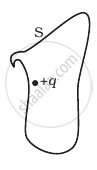 (i) |
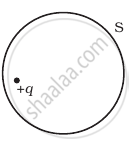 (ii) |
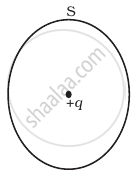 (iii) |
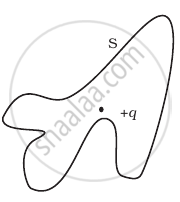 (iv) |
विकल्प
in Figure (iv) is the largest.
in Figure (iii) is the least.
in Figure (ii) is same as Figure (iii) but is smaller than Figure (iv)
is the same for all the figures.
Advertisements
उत्तर
is the same for all the figures.
Explanation:
According to Gauss’ law of electrostatics, the total electric flux out of a closed surface is equal to the charge enclosed divided by the permittivity,
i.e., `phi = (Q_(enclosed))/ε_0`
Thus, electric flux through a surface doesn’t depend on the shape, size or area of a surface but it depends on the amount of charge enclosed by the surface.
In the given figures the charge enclosed is the same that means the electric flux through all the surfaces should be the same.
APPEARS IN
संबंधित प्रश्न
State and explain Gauss’s law.
A point charge +10 μC is a distance 5 cm directly above the centre of a square of side 10 cm, as shown in the Figure. What is the magnitude of the electric flux through the square? (Hint: Think of the square as one face of a cube with edge 10 cm.)
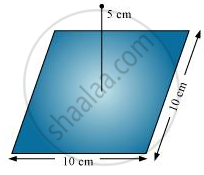
A charge Q is placed at the centre of a cube. Find the flux of the electric field through the six surfaces of the cube.
State Gauss’s law for magnetism. Explain its significance.
State Gauss's law in electrostatics. Show, with the help of a suitable example along with the figure, that the outward flux due to a point charge 'q'. in vacuum within a closed surface, is independent of its size or shape and is given by `q/ε_0`
Gaussian surface cannot pass through discrete charge because ____________.
Gauss' law helps in ______
If `oint_s` E.dS = 0 over a surface, then ______.
- the electric field inside the surface and on it is zero.
- the electric field inside the surface is necessarily uniform.
- the number of flux lines entering the surface must be equal to the number of flux lines leaving it.
- all charges must necessarily be outside the surface.
Consider a region inside which there are various types of charges but the total charge is zero. At points outside the region
- the electric field is necessarily zero.
- the electric field is due to the dipole moment of the charge distribution only.
- the dominant electric field is `∞ 1/r^3`, for large r, where r is the distance from a origin in this region.
- the work done to move a charged particle along a closed path, away from the region, will be zero.
An arbitrary surface encloses a dipole. What is the electric flux through this surface?
In 1959 Lyttleton and Bondi suggested that the expansion of the Universe could be explained if matter carried a net charge. Suppose that the Universe is made up of hydrogen atoms with a number density N, which is maintained a constant. Let the charge on the proton be: ep = – (1 + y)e where e is the electronic charge.
- Find the critical value of y such that expansion may start.
- Show that the velocity of expansion is proportional to the distance from the centre.
A charge of +5 μC is placed at the centre of two concentric spheres of radii r1 = 3 cm and r2 = 5 cm. The ratio of the flux through sphere of radius r1 to that through sphere of radius r2 will be ______.
For a Gaussian surface to be convenient for calculations, the electric field should be:
What is the SI unit of permittivity of free space (ε₀)?
For an infinite line charge with linear charge density λ, the electric field at distance r from the wire is:
For a uniformly charged thin spherical shell of radius R with total charge Q, the electric field outside the shell (r > R) is:
In a non-uniform electric field given by \[\vec{E} = \alpha x^{1/2} \hat{i}\] with \[\alpha = 800 \text{ N C}^{-1}\text{m}^{-1/2}\], the flux through a cube of side a = 0.1 m oriented with faces perpendicular to the x-axis is approximately:
