Advertisements
Advertisements
प्रश्न
State Gauss’s law for magnetism. Explain its significance.
Advertisements
उत्तर
Gauss's law of magnetism states that net magnetic flux through a closed surface (Gaussian surface) is zero. Mathematically
`oint vecB.dvecs = 0`
Gauss’s Law for magnetism tells us that magnetic monopoles do not exist
APPEARS IN
संबंधित प्रश्न
State and explain Gauss’s law.
Draw a graph of electric field E(r) with distance r from the centre of the shell for 0 ≤ r ≤ ∞.
Answer the following question.
State Gauss's law for magnetism. Explain its significance.
Five charges q1, q2, q3, q4, and q5 are fixed at their positions as shown in figure. S is a Gaussian surface. The Gauss’s law is given by `oint_s E.ds = q/ε_0`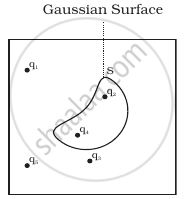
Which of the following statements is correct?
If `oint_s` E.dS = 0 over a surface, then ______.
- the electric field inside the surface and on it is zero.
- the electric field inside the surface is necessarily uniform.
- the number of flux lines entering the surface must be equal to the number of flux lines leaving it.
- all charges must necessarily be outside the surface.
Refer to the arrangement of charges in figure and a Gaussian surface of radius R with Q at the centre. Then

- total flux through the surface of the sphere is `(-Q)/ε_0`.
- field on the surface of the sphere is `(-Q)/(4 piε_0 R^2)`.
- flux through the surface of sphere due to 5Q is zero.
- field on the surface of sphere due to –2Q is same everywhere.
What is the SI unit of permittivity of free space (ε₀)?
For an infinite line charge with linear charge density λ, the electric field at distance r from the wire is:
The electric field due to a uniformly charged infinite plane sheet with surface charge density σ is:
For a uniformly charged thin spherical shell, what is the electric field at any point inside the shell (r < R)?
