Advertisements
Advertisements
Question
Five charges q1, q2, q3, q4, and q5 are fixed at their positions as shown in figure. S is a Gaussian surface. The Gauss’s law is given by `oint_s E.ds = q/ε_0`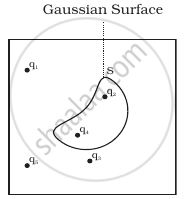
Which of the following statements is correct?
Options
E on the LHS of the above equation will have a contribution from q1, q5 and q3 while q on the RHS will have a contribution from q2 and q4 only.
E on the LHS of the above equation will have a contribution from all charges while q on the RHS will have a contribution from q2 and q4 only.
E on the LHS of the above equation will have a contribution from all charges while q on the RHS will have a contribution from q1, q3 and q5 only.
Both E on the LHS and q on the RHS will have contributions from q2 and q4 only.
Advertisements
Solution
E on the LHS of the above equation will have a contribution from all charges while q on the RHS will have a contribution from q2 and q4 only.
Explanation:
According to Gauss’ law, the term `q_(enclosed)` on the right side of the equation `oint_s E.ds = q_(enclosed)/ε_0` includes the sum of all charges enclosed by the surface called (Gaussian surface). In left side equation, the electric field is due to all the charges present both inside as well as outside the Gaussian surface.
APPEARS IN
RELATED QUESTIONS
State and explain Gauss’s law.
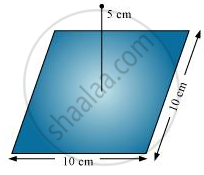
A point charge +10 μC is a distance 5 cm directly above the centre of a square of side 10 cm, as shown in the Figure. What is the magnitude of the electric flux through the square? (Hint: Think of the square as one face of a cube with edge 10 cm.)
A charge ‘q’ is placed at the centre of a cube of side l. What is the electric flux passing through each face of the cube?
A thin conducting spherical shell of radius R has charge Q spread uniformly over its surface. Using Gauss’s law, derive an expression for an electric field at a point outside the shell.
State Gauss's law in electrostatics. Show, with the help of a suitable example along with the figure, that the outward flux due to a point charge 'q'. in vacuum within a closed surface, is independent of its size or shape and is given by `q/ε_0`
State Gauss’s law on electrostatics and drive expression for the electric field due to a long straight thin uniformly charged wire (linear charge density λ) at a point lying at a distance r from the wire.
If `oint_s` E.dS = 0 over a surface, then ______.
- the electric field inside the surface and on it is zero.
- the electric field inside the surface is necessarily uniform.
- the number of flux lines entering the surface must be equal to the number of flux lines leaving it.
- all charges must necessarily be outside the surface.
Refer to the arrangement of charges in figure and a Gaussian surface of radius R with Q at the centre. Then

- total flux through the surface of the sphere is `(-Q)/ε_0`.
- field on the surface of the sphere is `(-Q)/(4 piε_0 R^2)`.
- flux through the surface of sphere due to 5Q is zero.
- field on the surface of sphere due to –2Q is same everywhere.
If the total charge enclosed by a surface is zero, does it imply that the elecric field everywhere on the surface is zero? Conversely, if the electric field everywhere on a surface is zero, does it imply that net charge inside is zero.
The region between two concentric spheres of radii a < b contain volume charge density ρ(r) = `"c"/"r"`, where c is constant and r is radial- distanct from centre no figure needed. A point charge q is placed at the origin, r = 0. Value of c is in such a way for which the electric field in the region between the spheres is constant (i.e. independent of r). Find the value of c:
Which of the following is NOT a property of a Gaussian surface?
The integral form of Gauss's Law is given by:
What is the SI unit of permittivity of free space (ε₀)?
For an infinite line charge with linear charge density λ, the electric field at distance r from the wire is:
The electric field due to a uniformly charged infinite plane sheet with surface charge density σ is:
For a uniformly charged thin spherical shell, what is the electric field at any point inside the shell (r < R)?
In a non-uniform electric field given by \[\vec{E} = \alpha x^{1/2} \hat{i}\] with \[\alpha = 800 \text{ N C}^{-1}\text{m}^{-1/2}\], the flux through a cube of side a = 0.1 m oriented with faces perpendicular to the x-axis is approximately:
For the cylinder in the piecewise-uniform field, the charge enclosed is:
