Advertisements
Advertisements
Question
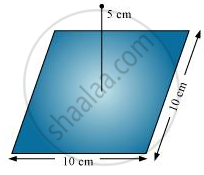
A point charge +10 μC is a distance 5 cm directly above the centre of a square of side 10 cm, as shown in the Figure. What is the magnitude of the electric flux through the square? (Hint: Think of the square as one face of a cube with edge 10 cm.)
Advertisements
Solution

Based on the illustration, we can assume that the given square represents one side of a cube with an edge length of 10 cm.
The cube encloses the +10 µC charge because it is located 5 cm above the square’s center. According to Gauss’s theorem, cube-linked electric flow is:
Φ = `q/ε_0`
= `(10 xx 10^-6)/(8.85 xx 10^-12)`
= 1.13 × 10⁶ N m2 C−1
Since the charge is at the centre, the flux is equally distributed through the 6 faces of the cube.
Therefore, flux through one square face:
Φsq = `Φ/6`
= `1.13/6 xx 10^6`
= 0.188 × 10⁶ N m2 C−1
or Φsq = 1.9 × 10⁵ N m2 C−1
APPEARS IN
RELATED QUESTIONS
State and explain Gauss’s law.
A charge ‘q’ is placed at the centre of a cube of side l. What is the electric flux passing through each face of the cube?
Draw a graph of electric field E(r) with distance r from the centre of the shell for 0 ≤ r ≤ ∞.
State Gauss’s law on electrostatics and drive expression for the electric field due to a long straight thin uniformly charged wire (linear charge density λ) at a point lying at a distance r from the wire.
The Gaussian surface ______.
Which of the following statements is not true about Gauss’s law?
Five charges q1, q2, q3, q4, and q5 are fixed at their positions as shown in figure. S is a Gaussian surface. The Gauss’s law is given by `oint_s E.ds = q/ε_0`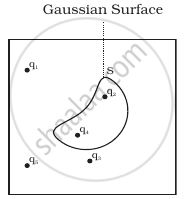
Which of the following statements is correct?
The region between two concentric spheres of radii a < b contain volume charge density ρ(r) = `"c"/"r"`, where c is constant and r is radial- distanct from centre no figure needed. A point charge q is placed at the origin, r = 0. Value of c is in such a way for which the electric field in the region between the spheres is constant (i.e. independent of r). Find the value of c:
A charge Q is placed at the centre of a cube. The electric flux through one of its faces is ______.
Which of the following is NOT a property of a Gaussian surface?
According to Gauss's Law, the total electric flux through a closed surface depends on:
The algebraic form of Gauss's Law is represented as:
What is the SI unit of permittivity of free space (ε₀)?
The electric field due to a uniformly charged infinite plane sheet with surface charge density σ is:
For a uniformly charged thin spherical shell of radius R with total charge Q, the electric field outside the shell (r > R) is:
Gauss's Law is equivalent to:
In a non-uniform electric field given by \[\vec{E} = \alpha x^{1/2} \hat{i}\] with \[\alpha = 800 \text{ N C}^{-1}\text{m}^{-1/2}\], the flux through a cube of side a = 0.1 m oriented with faces perpendicular to the x-axis is approximately:
For the cylinder in the piecewise-uniform field, the charge enclosed is:
