Advertisements
Advertisements
Question
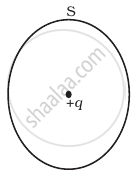
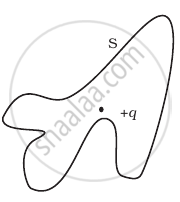
State Gauss's law in electrostatics. Show, with the help of a suitable example along with the figure, that the outward flux due to a point charge 'q'. in vacuum within a closed surface, is independent of its size or shape and is given by `q/ε_0`
Advertisements
Solution
Statement: The electric flux linked with a closed surface is equal to `(1)/ε_0` times the net charge enclosed by a closed surface.
Mathematical expression :
`Ø_"E" = oint vec"E".dvec"s" = (1)/(ε_0) (q_"net")`
Consider two spherical surfaces of radius r and 2r respectively and a charge 1 is enclosed in it. According to gauss theorem, the total electric flux linked with a closed surface depends on the charge enclosed in it so
(a)
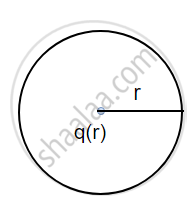
(b)
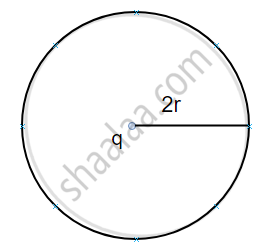
`Ø_E = q/ε_0 "and for fig"("b")`
`Ø_E = q/ε_0`.
APPEARS IN
RELATED QUESTIONS
A charge ‘q’ is placed at the centre of a cube of side l. What is the electric flux passing through each face of the cube?
A thin conducting spherical shell of radius R has charge Q spread uniformly over its surface. Using Gauss’s law, derive an expression for an electric field at a point outside the shell.
A charge Q is placed at the centre of a cube. Find the flux of the electric field through the six surfaces of the cube.
Answer the following question.
State Gauss's law for magnetism. Explain its significance.
State Gauss’s law on electrostatics and drive expression for the electric field due to a long straight thin uniformly charged wire (linear charge density λ) at a point lying at a distance r from the wire.
Gaussian surface cannot pass through discrete charge because ____________.
The Gaussian surface ______.
The surface considered for Gauss’s law is called ______.
Gauss' law helps in ______
The Electric flux through the surface
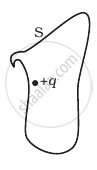 (i) |
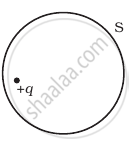 (ii) |
 (iii) |
 (iv) |
