Advertisements
Advertisements
प्रश्न
State Gauss's law in electrostatics. Show, with the help of a suitable example along with the figure, that the outward flux due to a point charge 'q'. in vacuum within a closed surface, is independent of its size or shape and is given by `q/ε_0`
Advertisements
उत्तर
Statement: The electric flux linked with a closed surface is equal to `(1)/ε_0` times the net charge enclosed by a closed surface.
Mathematical expression :
`Ø_"E" = oint vec"E".dvec"s" = (1)/(ε_0) (q_"net")`
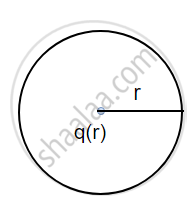
Consider two spherical surfaces of radius r and 2r respectively and a charge 1 is enclosed in it. According to gauss theorem, the total electric flux linked with a closed surface depends on the charge enclosed in it so
(a)
(b)
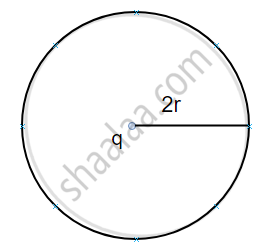
`Ø_E = q/ε_0 "and for fig"("b")`
`Ø_E = q/ε_0`.
APPEARS IN
संबंधित प्रश्न
Draw a graph of electric field E(r) with distance r from the centre of the shell for 0 ≤ r ≤ ∞.
A charge Q is placed at the centre of a cube. Find the flux of the electric field through the six surfaces of the cube.
Consider a region inside which there are various types of charges but the total charge is zero. At points outside the region
- the electric field is necessarily zero.
- the electric field is due to the dipole moment of the charge distribution only.
- the dominant electric field is `∞ 1/r^3`, for large r, where r is the distance from a origin in this region.
- the work done to move a charged particle along a closed path, away from the region, will be zero.
In 1959 Lyttleton and Bondi suggested that the expansion of the Universe could be explained if matter carried a net charge. Suppose that the Universe is made up of hydrogen atoms with a number density N, which is maintained a constant. Let the charge on the proton be: ep = – (1 + y)e where e is the electronic charge.
- Find the critical value of y such that expansion may start.
- Show that the velocity of expansion is proportional to the distance from the centre.
A Gaussian surface is best described as:
The integral form of Gauss's Law is given by:
For an infinite line charge with linear charge density λ, the electric field at distance r from the wire is:
The electric field due to a uniformly charged infinite plane sheet with surface charge density σ is:
For a uniformly charged thin spherical shell of radius R with total charge Q, the electric field outside the shell (r > R) is:
