Advertisements
Advertisements
प्रश्न
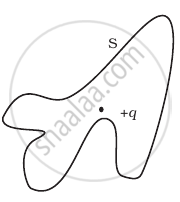
If the total charge enclosed by a surface is zero, does it imply that the elecric field everywhere on the surface is zero? Conversely, if the electric field everywhere on a surface is zero, does it imply that net charge inside is zero.
Advertisements
उत्तर
According to Gauss’ law, the flux associated with any closed surface is given by `int_s` E.dS = `q_(enclosed)/ε_0`. The term `q_(enclosed)` on the right side of the equation includes the sum of all charges enclosed by the surface called (Gaussian surface).
In the left side equation, the electric field is due to all the charges present both inside as well as outside the Gaussian surface.
Thus, despite being total charge enclosed by a surface zero, it doesn’t imply that the electric field everywhere on the surface is zero, the field may be normal to the surface.
Also, conversely if the electric field everywhere on a surface is zero.
APPEARS IN
संबंधित प्रश्न
State and explain Gauss’s law.
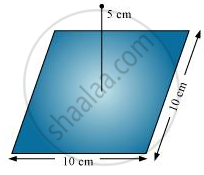
A point charge +10 μC is a distance 5 cm directly above the centre of a square of side 10 cm, as shown in the Figure. What is the magnitude of the electric flux through the square? (Hint: Think of the square as one face of a cube with edge 10 cm.)
A thin conducting spherical shell of radius R has charge Q spread uniformly over its surface. Using Gauss’s law, derive an expression for an electric field at a point outside the shell.
A charge Q is placed at the centre of a cube. Find the flux of the electric field through the six surfaces of the cube.
State Gauss’s law for magnetism. Explain its significance.
Answer the following question.
State Gauss's law for magnetism. Explain its significance.
State Gauss's law in electrostatics. Show, with the help of a suitable example along with the figure, that the outward flux due to a point charge 'q'. in vacuum within a closed surface, is independent of its size or shape and is given by `q/ε_0`
Gaussian surface cannot pass through discrete charge because ____________.
The Gaussian surface ______.
The surface considered for Gauss’s law is called ______.
Which of the following statements is not true about Gauss’s law?
The Electric flux through the surface
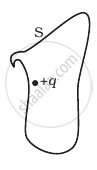 (i) |
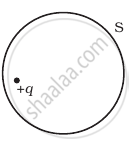 (ii) |
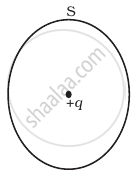 (iii) |
 (iv) |
Refer to the arrangement of charges in figure and a Gaussian surface of radius R with Q at the centre. Then

- total flux through the surface of the sphere is `(-Q)/ε_0`.
- field on the surface of the sphere is `(-Q)/(4 piε_0 R^2)`.
- flux through the surface of sphere due to 5Q is zero.
- field on the surface of sphere due to –2Q is same everywhere.
An arbitrary surface encloses a dipole. What is the electric flux through this surface?
In finding the electric field using Gauss law the formula `|vec"E"| = "q"_"enc"/(epsilon_0|"A"|)` is applicable. In the formula ε0 is permittivity of free space, A is the area of Gaussian surface and qenc is charge enclosed by the Gaussian surface. This equation can be used in which of the following situation?
A charge Q is placed at the centre of a cube. The electric flux through one of its faces is ______.
