Advertisements
Advertisements
Question
Refer to the arrangement of charges in figure and a Gaussian surface of radius R with Q at the centre. Then

- total flux through the surface of the sphere is `(-Q)/ε_0`.
- field on the surface of the sphere is `(-Q)/(4 piε_0 R^2)`.
- flux through the surface of sphere due to 5Q is zero.
- field on the surface of sphere due to –2Q is same everywhere.
Options
a and d
a and c
b and d
c and d
Advertisements
Solution
a and c
Explanation:
From Gauss' law, we know `oint_s vecE * dvecS = q_(enclosed)/ε_0`.
Thus, from figure, Total charge inside the Gaussian surface `q_(enclosed)` = Q – 2Q = – Q
The charge 5Q lies outside the surface, thus it makes no contribution to electric flux through the given surface.
APPEARS IN
RELATED QUESTIONS
Draw a graph of electric field E(r) with distance r from the centre of the shell for 0 ≤ r ≤ ∞.
State Gauss’s law for magnetism. Explain its significance.
Answer the following question.
State Gauss's law for magnetism. Explain its significance.
State Gauss's law in electrostatics. Show, with the help of a suitable example along with the figure, that the outward flux due to a point charge 'q'. in vacuum within a closed surface, is independent of its size or shape and is given by `q/ε_0`
Gaussian surface cannot pass through discrete charge because ____________.
q1, q2, q3 and q4 are point charges located at points as shown in the figure and S is a spherical gaussian surface of radius R. Which of the following is true according to the Gauss' law?

The Gaussian surface ______.
Gauss' law helps in ______
Five charges q1, q2, q3, q4, and q5 are fixed at their positions as shown in figure. S is a Gaussian surface. The Gauss’s law is given by `oint_s E.ds = q/ε_0`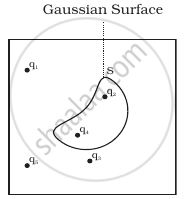
Which of the following statements is correct?
Consider a region inside which there are various types of charges but the total charge is zero. At points outside the region
- the electric field is necessarily zero.
- the electric field is due to the dipole moment of the charge distribution only.
- the dominant electric field is `∞ 1/r^3`, for large r, where r is the distance from a origin in this region.
- the work done to move a charged particle along a closed path, away from the region, will be zero.
An arbitrary surface encloses a dipole. What is the electric flux through this surface?
In finding the electric field using Gauss law the formula `|vec"E"| = "q"_"enc"/(epsilon_0|"A"|)` is applicable. In the formula ε0 is permittivity of free space, A is the area of Gaussian surface and qenc is charge enclosed by the Gaussian surface. This equation can be used in which of the following situation?
A charge of +5 μC is placed at the centre of two concentric spheres of radii r1 = 3 cm and r2 = 5 cm. The ratio of the flux through sphere of radius r1 to that through sphere of radius r2 will be ______.
A Gaussian surface is best described as:
According to Gauss's Law, the total electric flux through a closed surface depends on:
The electric field due to a uniformly charged infinite plane sheet with surface charge density σ is:
For the cylinder in the piecewise-uniform field, the charge enclosed is:
