Advertisements
Advertisements
Question
A charge ‘q’ is placed at the centre of a cube of side l. What is the electric flux passing through each face of the cube?
Advertisements
Solution
By using Gauss’s Law.
It is given as
`Phi = oint vecE*dvecs = q/in_0`
Now, the flux passing through all the six surfaces would be
`Phi = 6phi =q/in_0`
And the flux passing through each surface would be
`phi = q/(6in_0)`
RELATED QUESTIONS
Draw a graph of electric field E(r) with distance r from the centre of the shell for 0 ≤ r ≤ ∞.
Answer the following question.
State Gauss's law for magnetism. Explain its significance.
Five charges q1, q2, q3, q4, and q5 are fixed at their positions as shown in figure. S is a Gaussian surface. The Gauss’s law is given by `oint_s E.ds = q/ε_0`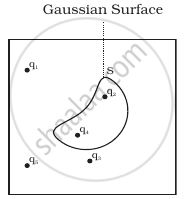
Which of the following statements is correct?
Consider a region inside which there are various types of charges but the total charge is zero. At points outside the region
- the electric field is necessarily zero.
- the electric field is due to the dipole moment of the charge distribution only.
- the dominant electric field is `∞ 1/r^3`, for large r, where r is the distance from a origin in this region.
- the work done to move a charged particle along a closed path, away from the region, will be zero.
A charge Q is placed at the centre of a cube. The electric flux through one of its faces is ______.
A charge of +5 μC is placed at the centre of two concentric spheres of radii r1 = 3 cm and r2 = 5 cm. The ratio of the flux through sphere of radius r1 to that through sphere of radius r2 will be ______.
For an infinite line charge with linear charge density λ, which Gaussian surface is most appropriate?
For a uniformly charged thin spherical shell of radius R with total charge Q, the electric field outside the shell (r > R) is:
For a uniformly charged thin spherical shell, what is the electric field at any point inside the shell (r < R)?
