Advertisements
Advertisements
प्रश्न
Three identical capacitors C1, C2 and C3 of capacitance 6 μF each are connected to a 12 V battery as shown.
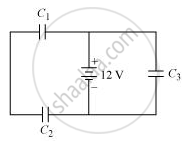
Find
(i) charge on each capacitor
(ii) equivalent capacitance of the network
(iii) energy stored in the network of capacitors
Advertisements
उत्तर
The 12 V battery is in parallel with C1, C2, and C3. C1 and C2are in series with each other while C3 is in parallel with the combination formed by C1and C2.
Total voltage drop across C3 = 12 V
q3 = CV
Where, q = Charge on the capacitor
C1, C2, C3 = 6 μF (Given in the question)
q3 = 6 × 12 = 72 μC
Voltage drop across C1 and C2 combined will be 12 V.
Let the voltage drop at C1 = V1
Let the voltage drop at C2 = V2
Then,
V = V1 + V2
`V_1 = q_1/C`
`V_2 = q_2/C`
`q_1/6+q_2/6 = 12`
As both the capacitors are in series,
`q_1 =q_2 =q`
Then,
`q{1/6 +1/6} =12`
`q xx 1/3 =12`
Or,
q = 36 micro coulombs
Thus, charge on each of C1 and C2 is 36 coulombs.
APPEARS IN
संबंधित प्रश्न
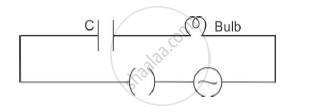
A bulb is connected in series with a variable capacitor and an AC source as shown. What happens to the brightness of the bulb when the key is plugged in and capacitance of the capacitor is gradually reduced?
The plates of a parallel-plate capacitor are made of circular discs of radii 5⋅0 cm each. If the separation between the plates is 1⋅0 mm, what is the capacitance?
A parallel-plate capacitor has plate area 100 cm2 and plate separation 1⋅0 cm. A glass plate (dielectric constant 6⋅0) of thickness 6⋅0 mm and an ebonite plate (dielectric constant 4⋅0) are inserted one over the other to fill the space between the plates of the capacitor. Find the new capacitance.
Two similar conducting spheres having charge+ q and -q are placed at 'd' seperation from each other in air. The radius of each ball is r and the separation between their centre is d (d >> r). Calculate the capacitance of the two ball system ______.

The displacement current of 4.425 µA is developed in the space between the plates of the parallel plate capacitor when voltage is changing at a rate of 106 Vs-1. The area of each plate of the capacitor is 40 cm2. The distance between each plate of the capacitor is x × 10-3 m. The value of x is ______.
(Permittivity of free space, ε0 = 8.85 × 10⁻¹²C2N-1m-2).
Eight drops of mercury of equal radius and possessing equal charge combine to form a big drop. The capacitance of bigger drop as compared to each small drop is ______.
What does a large capacitance mean in terms of charge storage and potential difference?
For a given capacitor, what fixes its capacitance?
In a series combination, which quantity is the same on each capacitor?
In a parallel combination, which quantity is the same across each capacitor?
