Advertisements
Advertisements
Question
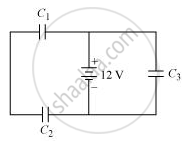
Three identical capacitors C1, C2 and C3 of capacitance 6 μF each are connected to a 12 V battery as shown.
Find
(i) charge on each capacitor
(ii) equivalent capacitance of the network
(iii) energy stored in the network of capacitors
Advertisements
Solution
The 12 V battery is in parallel with C1, C2, and C3. C1 and C2are in series with each other while C3 is in parallel with the combination formed by C1and C2.
Total voltage drop across C3 = 12 V
q3 = CV
Where, q = Charge on the capacitor
C1, C2, C3 = 6 μF (Given in the question)
q3 = 6 × 12 = 72 μC
Voltage drop across C1 and C2 combined will be 12 V.
Let the voltage drop at C1 = V1
Let the voltage drop at C2 = V2
Then,
V = V1 + V2
`V_1 = q_1/C`
`V_2 = q_2/C`
`q_1/6+q_2/6 = 12`
As both the capacitors are in series,
`q_1 =q_2 =q`
Then,
`q{1/6 +1/6} =12`
`q xx 1/3 =12`
Or,
q = 36 micro coulombs
Thus, charge on each of C1 and C2 is 36 coulombs.
APPEARS IN
RELATED QUESTIONS
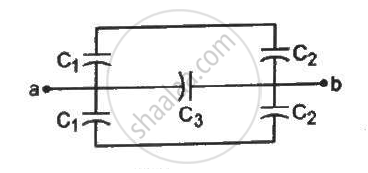
Find the equivalent capacitance of the system shown in figure between the points a and b.
A 5⋅0 µF capacitor is charged to 12 V. The positive plate of this capacitor is now connected to the negative terminal of a 12 V battery and vice versa. Calculate the heat developed in the connecting wires.
A sphercial capacitor is made of two conducting spherical shells of radii a and b. The space between the shells is filled with a dielectric of dielectric constant K up to a radius c as shown in figure . Calculate the capacitance.
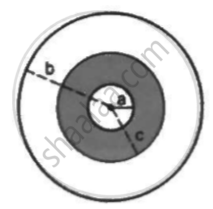
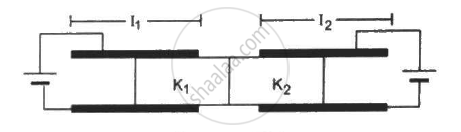
Figure shows two parallel plate capacitors with fixed plates and connected to two batteries. The separation between the plates is the same for the two capacitors. The plates are rectangular in shape with width b and lengths l1 and l2. The left half of the dielectric slab has a dielectric constant K1 and the right half K2. Neglecting any friction, find the ration of the emf of the left battery to that of the right battery for which the dielectric slab may remain in equilibrium.
If the voltage applied on a capacitor is increased from V to 2V, choose the correct conclusion.
A parallel plate capacitor stores a charge Q at a voltage V. Suppose the area of the parallel plate capacitor and the distance between the plates are each doubled then which is the quantity that will change?
Obtain the expression for capacitance for a parallel plate capacitor.
Between the plates of parallel plate condenser there is 1 mm thick medium shoot of dielectric constant 4. It is charged at 100 volt. The electric field in volt/meter between the plates of capacitor is ______.
The material filled between the plates of a parallel plate capacitor has a resistivity of 200Ωm. The value of the capacitance of the capacitor is 2 pF. If a potential difference of 40V is applied across the plates of the capacitor, then the value of leakage current flowing out of the capacitor is ______.
(given the value of relative permittivity of a material is 50.)
