Advertisements
Advertisements
प्रश्न
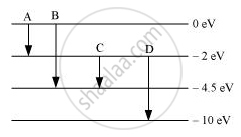
The energy levels of an atom are as shown below. Which of them will result in the transition of a photon of wavelength 275 nm?
Advertisements
उत्तर
Energy transitions for A,B,C, and D are:
A = 2 eV
B = 4.5 eV
C = 2.5 eV
D = 8 eV
`E=(hC)/lamda`
Where,
E = Energy transition
λ = Wavelength
h = 6.63 × 10⁻³⁴ Js
C = 3 × 10⁸ m/s
For B, we have
`lambda = (6.63 xx 10^-34 xx 3 xx 10^8)/(4.5 xx 1.6 xx 10^-19)`
`lambda = 275`nm
Thus, B will result in transition of a photon of wavelength of 275 nm.
APPEARS IN
संबंधित प्रश्न
A difference of 2.3 eV separates two energy levels in an atom. What is the frequency of radiation emitted when the atom makes a transition from the upper level to the lower level?
A 12.3 eV electron beam is used to bombard gaseous hydrogen at room temperature. Upto which energy level the hydrogen atoms would be excited?
Calculate the wavelengths of the second member of Lyman series and second member of Balmer series.
Which transition corresponds to emission of radiation of maximum wavelength?
Energy of an electron at infinity from nucleus is ______.
Two H atoms in the ground state collide inelastically. The maximum amount by which their combined kinetic energy is reduced is ______.
The diagram shows the four energy levels of an electron in the Bohr model of the hydrogen atom. Identify the transition in which the emitted photon will have the highest energy.

What can happen when a hydrogen atom absorbs energy?
Which orbit number corresponds to the first excited state of hydrogen?
Which orbit number corresponds to the second excited state of hydrogen?
What is the sign of the energy of the electron in a hydrogen atom in bound states?
