Advertisements
Advertisements
प्रश्न
A 12.3 eV electron beam is used to bombard gaseous hydrogen at room temperature. Upto which energy level the hydrogen atoms would be excited?
Calculate the wavelengths of the second member of Lyman series and second member of Balmer series.
Advertisements
उत्तर
Let the hydrogen atoms be excited to nth energy level.
\[12 . 3 = 13 . 6\left( \frac{1}{1^2} - \frac{1}{n^2} \right)\]
\[ \Rightarrow 12 . 3 = 13 . 6 - \frac{13 . 6}{n^2}\]
\[ \Rightarrow \frac{13 . 6}{n^2} = 13 . 6 - 12 . 3 = 1 . 3\]
\[ \Rightarrow n^2 = \frac{13 . 6}{1 . 3}\]
\[ \Rightarrow n \approx 3\]
The formula for calculating the wavelength of Lyman series is given below:
n = 3
\[\therefore \frac{1}{\lambda} = R\left( 1 - \frac{1}{3^2} \right)\]
\[ \Rightarrow \frac{1}{\lambda} = \left( 1 . 09737 \times {10}^7 \right)\left( \frac{8}{9} \right)\]
\[ \Rightarrow \lambda = 1025 A^\circ\]
The formula for calculating the wavelength of Balmer series is given below:
For second member of Balmer series:
n = 4
\[\therefore \frac{1}{\lambda} = R\left( \frac{1}{4} - \frac{1}{4^2} \right)\]
\[ \Rightarrow \frac{1}{\lambda} = \left( 1 . 09737 \times {10}^7 \right)\left( \frac{3}{16} \right)\]
\[ \Rightarrow \lambda = 4861 A^\circ\]
APPEARS IN
संबंधित प्रश्न
The total energy of an electron in the first excited state of the hydrogen atom is about −3.4 eV.
What is the potential energy of the electron in this state?
Obtain the first Bohr’s radius and the ground state energy of a muonic hydrogen atom [i.e., an atom in which a negatively charged muon (μ−) of mass about 207 me orbits around a proton].
What are means by pair annihilation? Write a balanced equation for the same.
Wavelengths of the first lines of the Lyman series, Paschen series and Balmer series, in hydrogen spectrum are denoted by `lambda_L, lambda_P and lambda_B` respectively. Arrange these wavelengths in increasing order.
Which transition corresponds to emission of radiation of maximum wavelength?
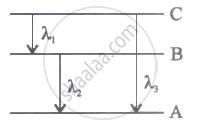
Energy levels A, B, C of acertain atom corresponding to increasing value of energy, i.e., EA< E8 < Ee. If λ1, λ2 and λ3 are the wavelength of radiations corresponding to the transitions C to B, B to A and C to A respectively, which of the following statements is correct?
What is the ionisation energy of hydrogen in the ground state?
What is the energy of the atom when the electron jumps to the third orbit?
How much energy is required to raise a hydrogen atom from the ground state to the second excited state?
Which orbit number corresponds to the first excited state of hydrogen?
