Advertisements
Advertisements
प्रश्न
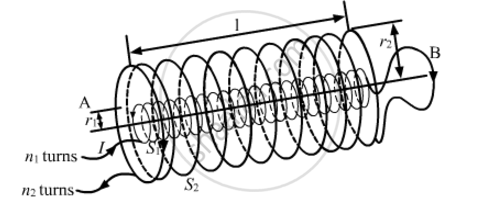
Two long coaxial insulated solenoids, S1 and S2 of equal lengths are wound one over the other as shown in the figure. A steady current "I" flow thought the inner solenoid S1 to the other end B, which is connected to the outer solenoid S2 through which the same current "I" flows in the opposite direction so as to come out at end A. If n1 and n2 are the number of turns per unit length, find the magnitude and direction of the net magnetic field at a point (i) inside on the axis and (ii) outside the combined system
Advertisements
उत्तर
(i) The magnetic field due to a current carrying solenoid:
B=μ0ni
where, n = number of turns per unit length
i = current through the solenoid
Now, the magnetic field due to solenoid S1 will be in the upward direction and the magnetic field due to S2 will be in the downward direction (by right-hand screw rule).
Bnet=BS1−BS2
⇒Bnet=μ0n1I−μ0n2I
=μ0I(n1−n2)
In the upward direction
(ii) The magnetic field is zero outside a solenoid.
APPEARS IN
संबंधित प्रश्न
A closely wound solenoid 80 cm long has 5 layers of windings of 400 turns each. The diameter of the solenoid is 1.8 cm. If the current carried is 8.0 A, estimate the magnitude of B inside the solenoid near its centre.
Obtain the expression for the magnetic energy stored in an inductor of self-inductance L to build up a current I through it.
A wire AB is carrying a steady current of 10 A and is lying on the table. Another wire CD carrying 6 A is held directly above AB at a height of 2 mm. Find the mass per unit length of the wire CD so that it remains suspended at its position when left free. Give the direction of the current flowing in CD with respect to that in AB. [Take the value of g = 10 ms−2]
A circular coil of one turn of radius 5.0 cm is rotated about a diameter with a constant angular speed of 80 revolutions per minute. A uniform magnetic field B = 0.010 T exists in a direction perpendicular to the axis of rotation. Suppose the ends of the coil are connected to a resistance of 100 Ω. Neglecting the resistance of the coil, find the heat produced in the circuit in one minute.
The magnetic field B inside a long solenoid, carrying a current of 5.00 A, is 3.14 × 10⁻² T. Find the number of turns per unit length of the solenoid.
A solenoid is defined as a long helical coil of insulated wire with many closely spaced turns. Which geometric condition must it satisfy to be classified as a 'long' solenoid?
During the construction of a solenoid, why is enamelled copper wire used for winding the helical turns?
A solenoid has a total of \(N\) turns wound uniformly over a length \(l\). What is the expression for the number of turns per unit length?
Which of the following correctly compares the field inside a toroid with the field inside a solenoid?
Solenoid valves used in washing machines and car engines serve what function?
