Advertisements
Advertisements
प्रश्न
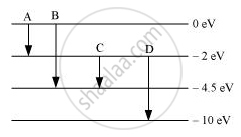
The energy levels of an atom are as shown below. Which of them will result in the transition of a photon of wavelength 275 nm?
Advertisements
उत्तर
Energy transitions for A,B,C, and D are:
A = 2 eV
B = 4.5 eV
C = 2.5 eV
D = 8 eV
`E=(hC)/lamda`
Where,
E = Energy transition
λ = Wavelength
h = 6.63 × 10⁻³⁴ Js
C = 3 × 10⁸ m/s
For B, we have
`lambda = (6.63 xx 10^-34 xx 3 xx 10^8)/(4.5 xx 1.6 xx 10^-19)`
`lambda = 275`nm
Thus, B will result in transition of a photon of wavelength of 275 nm.
APPEARS IN
संबंधित प्रश्न
The ground state energy of a hydrogen atom is −13.6 eV. What are the kinetic and potential energies of the electron in this state?
The total energy of an electron in the first excited state of the hydrogen atom is about −3.4 eV.
What is the potential energy of the electron in this state?
The total energy of an electron in the first excited state of the hydrogen atom is about −3.4 eV.
Which of the answers above would change if the choice of the zero of potential energy is changed?
A 12.9 eV beam of electronic is used to bombard gaseous hydrogen at room temperature. Upto which energy level the hydrogen atoms would be excited ?
Calculate the wavelength of the first member of Paschen series and first member of Balmer series.
Draw the energy level diagram showing how the line spectra corresponding to Paschen series occur due to transition between energy levels.
A Carnot engine absorbs 1000 J of heat energy from a reservoir at 127°C and rejects 600 J of heat energy during each cycle. The efficiency of the engine and temperature of the sink will be:
The diagram shows the four energy levels of an electron in the Bohr model of the hydrogen atom. Identify the transition in which the emitted photon will have the highest energy.

Which state corresponds to the lowest energy of the hydrogen atom?
What is the sign of the energy of the electron in a hydrogen atom in bound states?
How does the energy of the electron change as the orbit number increases?
