Advertisements
Advertisements
प्रश्न
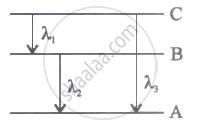
Which transition corresponds to emission of radiation of maximum wavelength?
Advertisements
उत्तर
`E = (hC)/lambda`
`lambda = (hC)/E`
For maximum wavelength, energy transition should be minimum.
A undergoes minimum energy transition.
A = 2 eV
Thus, photon in A will have the maximum wavelength.
APPEARS IN
संबंधित प्रश्न
A 12.5 eV electron beam is used to bombard gaseous hydrogen at room temperature. Upto which energy level the hydrogen atoms would be excited? Calculate the wavelengths of the first member of Lyman and first member of Balmer series.
A difference of 2.3 eV separates two energy levels in an atom. What is the frequency of radiation emitted when the atom makes a transition from the upper level to the lower level?
A hydrogen atom initially in the ground level absorbs a photon, which excites it to the n = 4 level. Determine the wavelength and frequency of the photon.
What are means by pair annihilation? Write a balanced equation for the same.
Draw the energy level diagram showing how the line spectra corresponding to Paschen series occur due to transition between energy levels.
A Carnot engine absorbs 1000 J of heat energy from a reservoir at 127°C and rejects 600 J of heat energy during each cycle. The efficiency of the engine and temperature of the sink will be:
Energy levels A, B, C of acertain atom corresponding to increasing value of energy, i.e., EA< E8 < Ee. If λ1, λ2 and λ3 are the wavelength of radiations corresponding to the transitions C to B, B to A and C to A respectively, which of the following statements is correct?
Two H atoms in the ground state collide inelastically. The maximum amount by which their combined kinetic energy is reduced is ______.
Which of the following is true for X-rays?
Which orbit number corresponds to the second excited state of hydrogen?
