Topics
Electric Charges and Fields
- Electric Charges
- Conductors and Insulators
- Properties of Electric Charge
- Coulomb’s Law
- Forces between Multiple Charges
- Electric Field
- Electric Field Due to a System of Charges
- Physical Significance of Electric Field
- Electric Field Lines
- Electric Flux
- Electric Dipole
- Dipole in a Uniform External Field
- Continuous Charge Distribution
- Gauss’s Law
- Application of Gauss' Law
Electrostatics
Current Electricity
Electrostatic Potential and Capacitance
- Electric Potential and Potential Energy
- Electrostatic Potential
- Electric Potential Due to a Point Charge
- Potential Due to an Electric Dipole
- Potential due to a System of Charges
- Equipotential Surfaces
- Relation Between Electric Field and Electrostatic Potential
- Potential Energy of a System of Charges
- Potential Energy of a Single Charge
- Potential Energy of a System of Two Charges in an External Field
- Potential Energy of a Dipole in an External Field
- Electrostatics of Conductors
- Dielectrics and Polarisation
- Capacitors and Capacitance
- The Parallel Plate Capacitor
- Effect of Dielectric on Capacitance
- Combination of Capacitors
- Energy Stored in a Charged Capacitor
Magnetic Effects of Current and Magnetism
Current Electricity
- Electric Current
- Electric Currents in Conductors
- Ohm's Law
- Drift of Electrons and the Origin of Resistivity
- Mobility of Electrons
- Limitations of Ohm’s Law
- Resistivity of Various Materials
- Temperature Dependence of Resistivity
- Electrical Energy and Power in Conductors
- Cells, EMF, and Internal Resistance
- Cells in Series and in Parallel
- Kirchhoff’s Laws
- Wheatstone Bridge
Moving Charges and Magnetism
- Electromagnetism
- Magnetic force
- Motion in a Magnetic Field
- Magnetic Field Due to a Current-carrying Conductor: Biot-savart's Law
- Applications of Biot-Savart's Law > Magnetic Field at the Axis of a Circular Current-carrying Loop
- Ampere’s Circuital Law
- Solenoid
- Force Between Two Parallel Currents (Ampere’s Law)
- Torque on a Rectangular Current Loop in a Uniform Magnetic Field
- Circular Current Loop as a Magnetic Dipole
- Moving Coil Galvanometer
- Kirchhoff’s Laws
Electromagnetic Induction and Alternating Currents
Electromagnetic Waves
Magnetism and Matter
Optics
Electromagnetic Induction
Alternating Current
Dual Nature of Radiation and Matter
Atoms and Nuclei
Electromagnetic Waves
Electronic Devices
Ray Optics and Optical Instruments
- Ray Optics Or Geometrical Optics
- Reflection of Light by Spherical Mirrors
- Sign Convention for Reflection by Spherical Mirrors
- Focal Length of Spherical Mirrors
- Mirror Equation of Spherical Mirrors
- Refraction of Light
- Total Internal Reflection
- Applications of Total Internal Reflection
- Refraction at a Spherical Surfaces
- Refraction by a Lens
- Power of a Lens
- Combined Focal Length of Two Thin Lenses in Contact
- Refraction of Light through a Prism
- Introduction to Optical Instruments
- Microscope and it’s types
- Telescope
Wave Optics
- Introduction to Wave Optics
- Huygens Principle
- Refraction of a Plane Wave
- Refraction at a Rarer Medium
- Reflection of a Plane Wave by a Plane Surface
- Coherent and Incoherent Addition of Waves
- Interference of Light Waves and Young’s Experiment
- Diffraction of Light
- The Single Slit
- Seeing the Single Slit Diffraction Pattern
- Polarisation of Light
Communication Systems
Dual Nature of Radiation and Matter
- Understanding Dual Nature of Radiation and Matter
- Electron Emission
- Photoelectric Effect - Hertz’s Observations
- Photoelectric Effect - Hallwachs’ and Lenard’s Observations
- Experimental Study of Photoelectric Effect
- Effects of Intensity and Frequency on Photocurrent
- Photoelectric Effect and Wave Theory of Light
- Einstein’s Photoelectric Equation: Energy Quantum of Radiation
- Particle Nature of Light: The Photon
- Wave Nature of Matter
The Special Theory of Relativity
Atoms
Nuclei
Semiconductor Electronics - Materials, Devices and Simple Circuits
Communication Systems
- Detection of Amplitude Modulated Wave
- Production of Amplitude Modulated Wave
- Basic Terminology Used in Electronic Communication Systems
- Sinusoidal Waves
- Modulation and Its Necessity
- Amplitude Modulation (AM)
- Need for Modulation and Demodulation
- Satellite Communication
- Propagation of EM Waves
- Bandwidth of Transmission Medium
- Bandwidth of Signals
The Special Theory of Relativity
- The Special Theory of Relativity
- The Principle of Relativity
- Maxwell'S Laws
- Kinematical Consequences
- Dynamics at Large Velocity
- Energy and Momentum
- The Ultimate Speed
- Twin Paradox
Maharashtra State Board: Class 11
Introduction
A semiconductor is a material whose electrical conductivity lies between that of a conductor and an insulator. Common examples of semiconductor materials are silicon and germanium. When these materials are chemically pure and contain no intentional impurity atoms, they are called intrinsic semiconductors.
Maharashtra State Board: Class 11
Definition: Intrinsic Semiconductor
A pure semiconductor in which no impurity is added intentionally.
Maharashtra State Board: Class 11
Definition: Intrinsic Carrier Concentration
The concentration of charge carriers in an intrinsic semiconductor, where the number of electrons equals the number of holes.
Maharashtra State Board: Class 11
Definition: Hole
The vacancy left in the valence band when an electron leaves it behaves like a positive charge carrier in semiconductor theory.
Maharashtra State Board: Class 11
Generation of Charge Carriers
At very low temperatures, a pure semiconductor behaves almost like an insulator because very few electrons are available for conduction. As temperature increases, some valence electrons gain enough energy to move into the conduction band, leaving behind vacancies called holes.
Each electron that enters the conduction band leaves one hole behind in the valence band. Therefore, in an intrinsic semiconductor, electrons and holes are created in equal numbers.
Important idea
- One electron promoted to the conduction band produces one hole in the valence band.
- Hence, in intrinsic semiconductors, electron concentration equals hole concentration.
- This equality is the basis of the relation ne = nh = ni
Maharashtra State Board: Class 11
Temperature Dependence
The conductivity of an intrinsic semiconductor depends strongly on temperature. At 0 K, it behaves like an insulator because the valence band is full and the conduction band is empty.
When the temperature rises, some electrons cross the energy gap and become free charge carriers. As a result, the number of electrons and holes increases, and conductivity also increases.
Maharashtra State Board: Class 11
Energy Band View
In an intrinsic semiconductor, the valence band is nearly full, and the conduction band is nearly empty at low temperature.
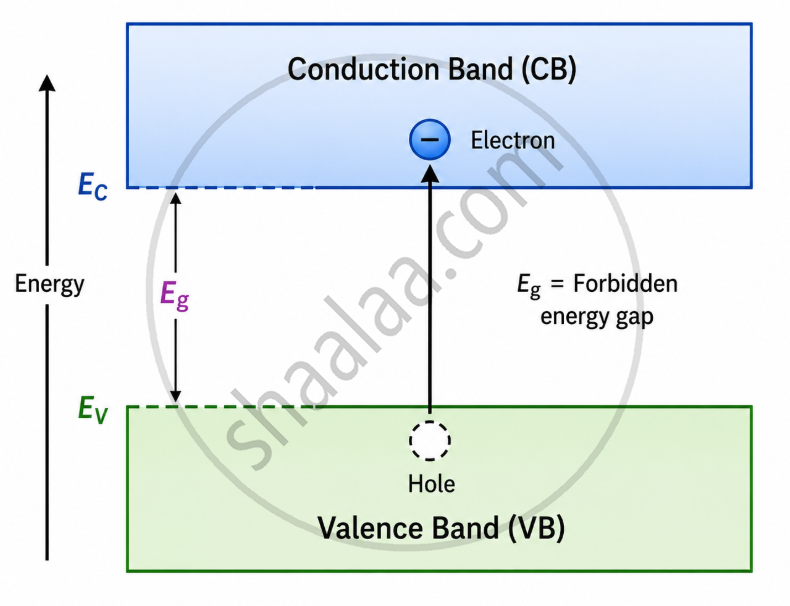
Flow sequence
Valence electron gains heat energy → moves to the conduction band → free electron is formed → hole is left behind → both contribute to conduction.
Maharashtra State Board: Class 11
Key Characteristics
- It is chemically pure; no impurity atoms are intentionally added.
- The number of electrons equals the number of holes.
- Conductivity is low at low temperatures and increases with temperature.
- Conduction occurs due to both free electrons and holes.
- Pure silicon and pure germanium are common examples.
Maharashtra State Board: Class 11
Intrinsic vs Extrinsic
| Feature | Intrinsic Semiconductor | Extrinsic Semiconductor |
|---|---|---|
| Purity | Pure semiconductor material. | A semiconductor with intentionally added impurity atoms. |
| Charge carriers | Electrons and holes are equal in number. | One type of charge carrier is usually the majority carrier. |
| Conductivity | Relatively low. | Higher than an intrinsic semiconductor. |
| Examples | Pure Si, pure Ge. | n-type and p-type semiconductors. |
| Exam relevance | Basic concept and definition questions. | Common comparison and application questions. |
Example
C, Si and Ge have the same lattice structure. Why is C an insulator while Si and Ge are intrinsic semiconductors?
Carbon (C), silicon (Si), and germanium (Ge) have the same crystal structure, but their electrons are held with different strengths. Carbon has a much larger energy gap, so its electrons cannot easily move to the conduction band. As a result, almost no free electrons are available for conduction, making carbon an insulator. Silicon and germanium have smaller energy gaps, so some electrons gain enough energy at room temperature to move into the conduction band. Therefore, Si and Ge behave as intrinsic semiconductors.
Maharashtra State Board: Class 11
Real-Life Understanding
Imagine a classroom in which every student is seated properly, so no one is free to move around. This is similar to a semiconductor at very low temperature, where electrons are tightly bound and conduction is minimal.
If some students get up and move to empty spaces elsewhere, they create both moving students and vacant seats. Similarly, when an electron gains energy and moves into the conduction band, it creates a free electron and a hole simultaneously.
Everyday significance
Pure semiconductors are not usually used directly in most electronic devices because their conductivity is limited. However, understanding intrinsic semiconductors is essential because extrinsic semiconductors and all basic semiconductor devices are built on this concept.
