Topics
Electrostatics
Electric Charges and Fields
- Electric Charges
- Conductors and Insulators
- Properties of Electric Charge
- Coulomb’s Law
- Forces between Multiple Charges
- Electric Field
- Electric Field Due to a System of Charges
- Physical Significance of Electric Field
- Electric Field Lines
- Electric Flux
- Electric Dipole
- Dipole in a Uniform External Field
- Continuous Charge Distribution
- Gauss’s Law
- Application of Gauss' Law
Current Electricity
Electrostatic Potential and Capacitance
- Electric Potential and Potential Energy
- Electrostatic Potential
- Electric Potential Due to a Point Charge
- Potential Due to an Electric Dipole
- Potential due to a System of Charges
- Equipotential Surfaces
- Relation Between Electric Field and Electrostatic Potential
- Potential Energy of a System of Charges
- Potential Energy of a Single Charge
- Potential Energy of a System of Two Charges in an External Field
- Potential Energy of a Dipole in an External Field
- Electrostatics of Conductors
- Dielectrics and Polarisation
- Capacitors and Capacitance
- The Parallel Plate Capacitor
- Effect of Dielectric on Capacitance
- Combination of Capacitors
- Energy Stored in a Charged Capacitor
Magnetic Effects of Current and Magnetism
Current Electricity
- Electric Current
- Electric Currents in Conductors
- Ohm's Law
- Drift of Electrons and the Origin of Resistivity
- Mobility of Electrons
- Limitations of Ohm’s Law
- Resistivity of Various Materials
- Temperature Dependence of Resistivity
- Electrical Energy and Power in Conductors
- Cells, EMF, and Internal Resistance
- Cells in Series and in Parallel
- Kirchhoff’s Laws
- Wheatstone Bridge
Moving Charges and Magnetism
- Electromagnetism
- Magnetic force
- Motion in a Magnetic Field
- Magnetic Field Due to a Current-carrying Conductor: Biot-savart's Law
- Applications of Biot-Savart's Law > Magnetic Field at the Axis of a Circular Current-carrying Loop
- Ampere’s Circuital Law
- Solenoid
- Force Between Two Parallel Currents (Ampere’s Law)
- Torque on a Rectangular Current Loop in a Uniform Magnetic Field
- Circular Current Loop as a Magnetic Dipole
- Moving Coil Galvanometer
- Kirchhoff’s Laws
Electromagnetic Induction and Alternating Currents
Electromagnetic Waves
Magnetism and Matter
Optics
Electromagnetic Induction
Alternating Current
Dual Nature of Radiation and Matter
Atoms and Nuclei
Electromagnetic Waves
Electronic Devices
Ray Optics and Optical Instruments
- Ray Optics Or Geometrical Optics
- Reflection of Light by Spherical Mirrors
- Sign Convention for Reflection by Spherical Mirrors
- Focal Length of Spherical Mirrors
- Mirror Equation of Spherical Mirrors
- Refraction of Light
- Total Internal Reflection
- Applications of Total Internal Reflection
- Refraction at a Spherical Surfaces
- Refraction by a Lens
- Power of a Lens
- Combined Focal Length of Two Thin Lenses in Contact
- Refraction of Light through a Prism
- Introduction to Optical Instruments
- Microscope and it’s types
- Telescope
Wave Optics
- Introduction to Wave Optics
- Huygens Principle
- Refraction of a Plane Wave
- Refraction at a Rarer Medium
- Reflection of a Plane Wave by a Plane Surface
- Coherent and Incoherent Addition of Waves
- Interference of Light Waves and Young’s Experiment
- Diffraction of Light
- The Single Slit
- Seeing the Single Slit Diffraction Pattern
- Polarisation of Light
Communication Systems
Dual Nature of Radiation and Matter
- Understanding Dual Nature of Radiation and Matter
- Electron Emission
- Photoelectric Effect - Hertz’s Observations
- Photoelectric Effect - Hallwachs’ and Lenard’s Observations
- Experimental Study of Photoelectric Effect
- Effects of Intensity and Frequency on Photocurrent
- Photoelectric Effect and Wave Theory of Light
- Einstein’s Photoelectric Equation: Energy Quantum of Radiation
- Particle Nature of Light: The Photon
- Wave Nature of Matter
The Special Theory of Relativity
Atoms
Nuclei
Semiconductor Electronics - Materials, Devices and Simple Circuits
Communication Systems
- Detection of Amplitude Modulated Wave
- Production of Amplitude Modulated Wave
- Basic Terminology Used in Electronic Communication Systems
- Sinusoidal Waves
- Modulation and Its Necessity
- Amplitude Modulation (AM)
- Need for Modulation and Demodulation
- Satellite Communication
- Propagation of EM Waves
- Bandwidth of Transmission Medium
- Bandwidth of Signals
The Special Theory of Relativity
- The Special Theory of Relativity
- The Principle of Relativity
- Maxwell'S Laws
- Kinematical Consequences
- Dynamics at Large Velocity
- Energy and Momentum
- The Ultimate Speed
- Twin Paradox
Maharashtra State Board: Class 7, 11
CISCE: Class 12
Definition: Magnet
A magnet is a material that produces a magnetic field and can attract magnetic substances such as iron, nickel, cobalt, and some of their alloys.
Maharashtra State Board: Class 11
CISCE: Class 12
Definition: Magnetic Field
The region around a magnet in which it can exert a magnetic force is called its magnetic field.
Maharashtra State Board: Class 11
CISCE: Class 12
Magnet
A common permanent magnet is a bar magnet. It has two ends called magnetic poles:
- North-seeking pole (N-pole): The end that points approximately towards geographic north when the magnet is freely suspended.
- South-seeking pole (S-pole): The end that points approximately towards geographic south.
Important observations
- Like poles repel each other: N repels N and S repels S.
- Unlike poles attract each other: N attracts S.
- A freely suspended bar magnet settles approximately along the geographic north–south direction.
Maharashtra State Board: Class 11
CISCE: Class 12
Magnetic Field and Field Lines
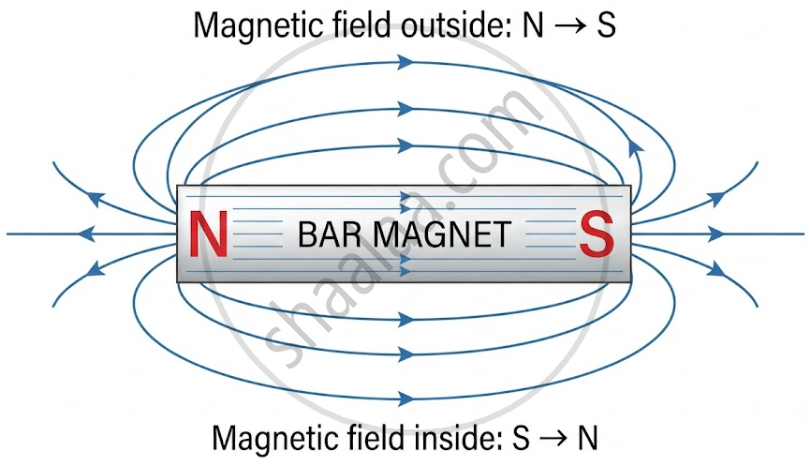
Magnetic field lines are imaginary lines used to represent the magnetic field around a magnet.
Rules for magnetic field lines
- Outside a bar magnet, field lines emerge from the north pole and enter the south pole.
- Inside the magnet, they travel from the south pole to the north pole.
- Therefore, magnetic field lines form continuous closed loops.
- Field lines never intersect each other.
- Where field lines are closer together, the magnetic field is stronger.
- The field is strongest near the poles of a magnet.
Maharashtra State Board: Class 11
CISCE: Class 12
When a Magnet is Broken
- Suppose a bar magnet is cut into two pieces.
- Each piece becomes a smaller magnet with its own north pole and south pole.
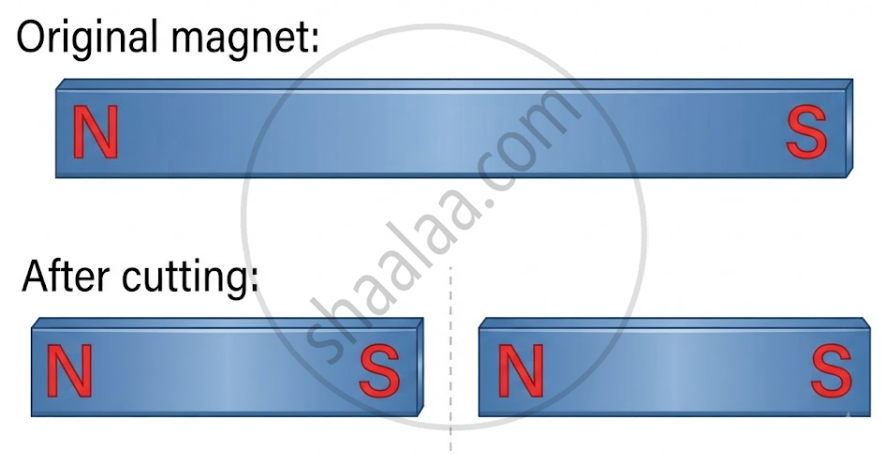
Thus, cutting a magnet does not produce an isolated north pole or an isolated south pole. In ordinary magnets, poles always occur in pairs. Isolated magnetic poles, called magnetic monopoles, have not been observed in ordinary magnetic materials.
Maharashtra State Board: Class 11
CISCE: Class 12
Compass Point North–South
- A compass needle is a small magnet mounted so that it can rotate freely.
- Earth produces its own magnetic field. Therefore, the compass needle experiences a turning effect and aligns itself with Earth’s magnetic field.
- This is why the needle points approximately in the north–south direction.
Real-life connection: Navigation
Before GPS, sailors, travellers, and surveyors used a compass for direction. A compass works because its magnetic needle aligns with Earth’s magnetic field.
Maharashtra State Board: Class 7, 11
CISCE: Class 12
Earth as a Giant Magnet
In 1600, the English scientist William Gilbert gave a scientific explanation for the north–south alignment of a freely suspended magnet. He concluded that Earth behaves approximately like a huge magnet.
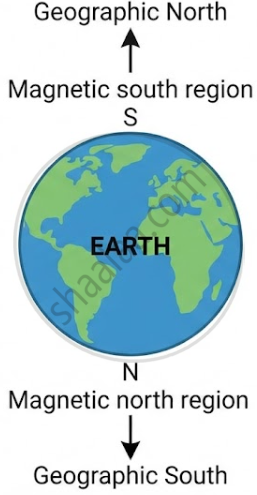
Earth’s magnetic field is similar in pattern to the field of a bar magnet. In the school-level model, Earth is treated as if a large bar magnet were placed inside it.
Key idea
The north pole of a freely suspended magnet points toward geographic north. Since unlike poles attract, the region near geographic north must behave like a magnetic south pole.
Similarly, the region near geographic south behaves like a magnetic north pole.
| Location on Earth | Magnetic behaviour in the simple Earth-magnet model |
|---|---|
| Near geographic North Pole | Magnetic south pole |
| Near geographic South Pole | Magnetic north pole |
The Earth’s magnetic field is approximately directed from geographic south to geographic north.
CISCE: Class 12
Brief history of magnetism
- Ancient peoples knew of natural magnetic ore, including in the region historically associated with Magnesia in Greece.
- William Gilbert systematically investigated magnetism and proposed that Earth behaves like a magnet.
- In 1820, Hans Christian Oersted showed that electric current produces a magnetic effect.
- Later work by Ampere, Biot, Savart, and Maxwell established the close relationship between electricity and magnetism.
Maharashtra State Board: Class 7, 11
CISCE: Class 12
Key Takeaways
- Every ordinary magnet has two poles: north and south.
- Like poles repel; unlike poles attract.
- A freely suspended magnet aligns approximately along the north–south direction.
- Magnetic field lines are closed loops.
- A broken magnet always produces smaller magnets, each with both poles.
- Earth behaves approximately like a giant magnet.
- Near geographic north lies Earth’s magnetic-south region in the simple bar-magnet model.
- A compass works because its needle aligns with Earth’s magnetic field.
