Topics
Electrostatics
Electric Charges and Fields
- Electric Charge
- Conductors and Insulators
- Properties of Electric Charge
- Coulomb’s Law
- Forces between Multiple Charges
- Electric Field
- Electric Field Due to a System of Charges
- Physical Significance of Electric Field
- Electric Field Lines
- Electric Flux
- Electric Dipole
- Dipole in a Uniform External Field
- Continuous Charge Distribution
- Gauss’s Law
- Application of Gauss' Law
Current Electricity
Electrostatic Potential and Capacitance
- Electric Potential and Potential Energy
- Electrostatic Potential
- Electric Potential Due to a Point Charge
- Potential Due to an Electric Dipole
- Potential due to a System of Charges
- Equipotential Surfaces
- Relation Between Electric Field and Electrostatic Potential
- Potential Energy of a System of Charges
- Potential Energy of a Single Charge
- Potential Energy of a System of Two Charges in an External Field
- Potential Energy of a Dipole in an External Field
- Electrostatics of Conductors
- Dielectrics and Polarisation
- Capacitors and Capacitance
- The Parallel Plate Capacitor
- Effect of Dielectric on Capacitance
- Combination of Capacitors
- Energy Stored in a Charged Capacitor
Magnetic Effects of Current and Magnetism
Current Electricity
- Electric Current
- Electric Currents in Conductors
- Ohm's Law
- Drift of Electrons and the Origin of Resistivity
- Mobility of Electrons
- Limitations of Ohm’s Law
- Resistivity of Various Materials
- Temperature Dependence of Resistivity
- Electrical Energy and Power in Conductors
- Cells, EMF, and Internal Resistance
- Cells in Series and in Parallel
- Kirchhoff’s Laws
- Wheatstone Bridge
Electromagnetic Induction and Alternating Currents
Moving Charges and Magnetism
- Electromagnetism
- Magnetic force
- Motion in a Magnetic Field
- Magnetic Field Due to a Current-carrying Conductor: Biot-savart's Law
- Applications of Biot-Savart's Law > Magnetic Field at the Axis of a Circular Current-carrying Loop
- Ampere’s Circuital Law
- Solenoid
- Force Between Two Parallel Currents (Ampere’s Law)
- Torque on a Rectangular Current Loop in a Uniform Magnetic Field
- Circular Current Loop as a Magnetic Dipole
- Moving Coil Galvanometer
- Kirchhoff’s Laws
Electromagnetic Waves
Magnetism and Matter
Electromagnetic Induction
Optics
Alternating Current
Dual Nature of Radiation and Matter
Atoms and Nuclei
Electromagnetic Waves
- Introduction to Electromagnetic Waves
- Displacement Current
- Sources of Electromagnetic Waves
- Nature of Electromagnetic Waves
- Electromagnetic Spectrum
- Definition and Characteristics of Electromagnetic Waves
Electronic Devices
Ray Optics and Optical Instruments
- Ray Optics Or Geometrical Optics
- Reflection of Light by Spherical Mirrors
- Sign Convention for Reflection by Spherical Mirrors
- Focal Length of Spherical Mirrors
- Mirror Equation of Spherical Mirrors
- Refraction of Light
- Total Internal Reflection
- Applications of Total Internal Reflection
- Refraction at a Spherical Surfaces
- Refraction by a Lens
- Power of a Lens
- Combined Focal Length of Two Thin Lenses in Contact
- Refraction Through a Prism
- Introduction to Optical Instruments
- Microscope and it’s types
- Telescope
Wave Optics
- Introduction to Wave Optics
- Huygens Principle
- Refraction of a Plane Wave
- Refraction at a Rarer Medium
- Reflection of a Plane Wave by a Plane Surface
- Coherent and Incoherent Addition of Waves
- Interference of Light Waves and Young’s Experiment
- Diffraction of Light
- The Single Slit
- Seeing the Single Slit Diffraction Pattern
- Polarisation of Light
Communication Systems
Dual Nature of Radiation and Matter
- Understanding Dual Nature of Radiation and Matter
- Electron Emission
- Photoelectric Effect - Hertz’s Observations
- Photoelectric Effect - Hallwachs’ and Lenard’s Observations
- Experimental Study of Photoelectric Effect
- Effects of Intensity and Frequency on Photocurrent
- Photoelectric Effect and Wave Theory of Light
- Einstein’s Photoelectric Equation: Energy Quantum of Radiation
- Particle Nature of Light: The Photon
- Wave Nature of Matter
The Special Theory of Relativity
Atoms
Nuclei
Semiconductor Electronics - Materials, Devices and Simple Circuits
Communication Systems
- Detection of Amplitude Modulated Wave
- Production of Amplitude Modulated Wave
- Basic Terminology Used in Electronic Communication Systems
- Sinusoidal Waves
- Modulation and Its Necessity
- Amplitude Modulation (AM)
- Need for Modulation and Demodulation
- Satellite Communication
- Propagation of EM Waves
- Bandwidth of Transmission Medium
- Bandwidth of Signals
The Special Theory of Relativity
- The Special Theory of Relativity
- The Principle of Relativity
- Maxwell'S Laws
- Kinematical Consequences
- Dynamics at Large Velocity
- Energy and Momentum
- The Ultimate Speed
- Twin Paradox
Definition: Solenoid
A solenoid is a long cylindrical coil of insulated wire wound closely in the shape of a helix. When an electric current is passed through it, it produces a magnetic field similar to that of a bar magnet, with one end acting as a north pole and the other as a south pole.
Similarity Between a Bar Magnet and a Solenoid
Think of a bar magnet as being made up of an enormous stack of tiny current loops (like the rings of a solenoid), each carrying a small circulating current. This is Ampere's hypothesis in action. Just as a solenoid with many turns of current-carrying wire produces a magnetic field at its poles, the atomic circulating currents inside a bar magnet produce the same effect.
Analogy: Imagine stacking hundreds of identical ring-shaped magnets (each = one current loop of a solenoid) end-to-end. The resulting field pattern outside the stack is indistinguishable from that of a bar magnet. A solenoid carrying current is exactly this stack.
Derivation
Consider a solenoid with:
| Symbol | Meaning |
|---|---|
| a | Radius of solenoid |
| 2l | Total length of solenoid (centre at O) |
| n | Number of turns per unit length |
| I | Current through solenoid |
| r | Distance of observation point P on the axis |
| dx | Small element at distance x from O |
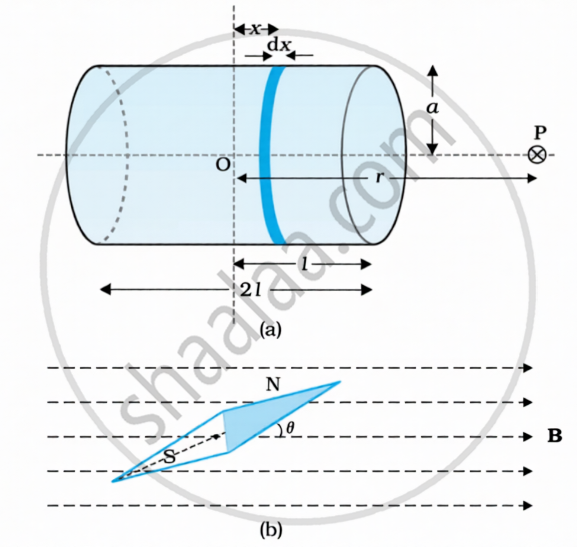
Step 1: Field due to one small element:
- A small element of thickness dx at distance x from O has ndx turns. The field at axial point P (at distance r) due to this element is:
dB = \[\frac{\mu_0ndxIa^2}{2\left[(r-x)^2+a^2\right]^{3/2}}\]
Step 2: Integrate over the full length:
- Integrate dB from x = −l to x = +l:
B = \[\frac{\mu_0nIa^2}{2}\int_{-l}^{+l}\frac{dx}{\left[(r-x)^2+a^2\right]^{3/2}}\]
Step 3: Apply the Far-Field Approximation:
- For the far axial field, apply the conditions r ≫ a and r ≫ l. The denominator simplifies to r3:
[(r − x)² + a²]³/² ≈ r3
Step 4: Final Result:
- B = \[{\frac{\mu_0}{4\pi}\cdot\frac{2m}{r^3}}\]
where m = nI(πa2)(2l) = total magnetic moment of the solenoid (= total turns × current × area).
Step 5: Conclusion:
- This expression is identical to the far axial field of a bar magnet:
Baxial (bar magnet) = \[{\frac{\mu_0}{4\pi}\cdot\frac{2m}{r^3}}\]
∴ The magnetic moment of the bar magnet = magnetic moment of the equivalent solenoid.
Key Points: Bar Magnet as an Equivalent Solenoid
- A bar magnet can be thought of as a large number of atomic circulating currents (Ampere's Hypothesis).
- The far axial magnetic field of both a bar magnet and a solenoid is B = \[\frac {μ_0}{4π}\]\[\frac {2m}{r^3}\], confirming equivalence.
- Equivalence holds only at far axial distances (r ≫ a, r ≫ l).
- The magnetic moment of the bar magnet = the magnetic moment of the equivalent solenoid (m = NIA).
- Similarities: field pattern, axial field formula, poles, directive and attractive properties.
- Key differences: a bar magnet is permanent, a solenoid is temporary; solenoid poles are reversible, bar magnet poles are fixed.
