Topics
Electrostatics
Electric Charges and Fields
- Electric Charge
- Conductors and Insulators
- Properties of Electric Charge
- Coulomb’s Law
- Forces between Multiple Charges
- Electric Field
- Electric Field Due to a System of Charges
- Physical Significance of Electric Field
- Electric Field Lines
- Electric Flux
- Electric Dipole
- Dipole in a Uniform External Field
- Continuous Charge Distribution
- Gauss’s Law
- Application of Gauss' Law
Current Electricity
Electrostatic Potential and Capacitance
- Electric Potential and Potential Energy
- Electrostatic Potential
- Electric Potential Due to a Point Charge
- Potential Due to an Electric Dipole
- Potential due to a System of Charges
- Equipotential Surfaces
- Relation Between Electric Field and Electrostatic Potential
- Potential Energy of a System of Charges
- Potential Energy of a Single Charge
- Potential Energy of a System of Two Charges in an External Field
- Potential Energy of a Dipole in an External Field
- Electrostatics of Conductors
- Dielectrics and Polarisation
- Capacitors and Capacitance
- The Parallel Plate Capacitor
- Effect of Dielectric on Capacitance
- Combination of Capacitors
- Energy Stored in a Charged Capacitor
Magnetic Effects of Current and Magnetism
Current Electricity
- Electric Current
- Electric Currents in Conductors
- Ohm's Law
- Drift of Electrons and the Origin of Resistivity
- Mobility of Electrons
- Limitations of Ohm’s Law
- Resistivity of Various Materials
- Temperature Dependence of Resistivity
- Electrical Energy and Power in Conductors
- Cells, EMF, and Internal Resistance
- Cells in Series and in Parallel
- Kirchhoff’s Laws
- Wheatstone Bridge
Electromagnetic Induction and Alternating Currents
Moving Charges and Magnetism
- Electromagnetism
- Magnetic force
- Motion in a Magnetic Field
- Magnetic Field Due to a Current-carrying Conductor: Biot-savart's Law
- Applications of Biot-Savart's Law > Magnetic Field at the Axis of a Circular Current-carrying Loop
- Ampere’s Circuital Law
- Solenoid
- Force Between Two Parallel Currents (Ampere’s Law)
- Torque on a Rectangular Current Loop in a Uniform Magnetic Field
- Circular Current Loop as a Magnetic Dipole
- Moving Coil Galvanometer
- Kirchhoff’s Laws
Electromagnetic Waves
Magnetism and Matter
Electromagnetic Induction
Optics
Alternating Current
Dual Nature of Radiation and Matter
Atoms and Nuclei
Electromagnetic Waves
- Introduction to Electromagnetic Waves
- Displacement Current
- Sources of Electromagnetic Waves
- Nature of Electromagnetic Waves
- Electromagnetic Spectrum
- Definition and Characteristics of Electromagnetic Waves
Electronic Devices
Ray Optics and Optical Instruments
- Ray Optics Or Geometrical Optics
- Reflection of Light by Spherical Mirrors
- Sign Convention for Reflection by Spherical Mirrors
- Focal Length of Spherical Mirrors
- Mirror Equation of Spherical Mirrors
- Refraction of Light
- Total Internal Reflection
- Applications of Total Internal Reflection
- Refraction at a Spherical Surfaces
- Refraction by a Lens
- Power of a Lens
- Combined Focal Length of Two Thin Lenses in Contact
- Refraction Through a Prism
- Introduction to Optical Instruments
- Microscope and it’s types
- Telescope
Communication Systems
Wave Optics
- Introduction to Wave Optics
- Huygens Principle
- Refraction of a Plane Wave
- Refraction at a Rarer Medium
- Reflection of a Plane Wave by a Plane Surface
- Coherent and Incoherent Addition of Waves
- Interference of Light Waves and Young’s Experiment
- Diffraction of Light
- The Single Slit
- Seeing the Single Slit Diffraction Pattern
- Polarisation of Light
The Special Theory of Relativity
Dual Nature of Radiation and Matter
- Understanding Dual Nature of Radiation and Matter
- Electron Emission
- Photoelectric Effect - Hertz’s Observations
- Photoelectric Effect - Hallwachs’ and Lenard’s Observations
- Experimental Study of Photoelectric Effect
- Effects of Intensity and Frequency on Photocurrent
- Photoelectric Effect and Wave Theory of Light
- Einstein’s Photoelectric Equation: Energy Quantum of Radiation
- Particle Nature of Light: The Photon
- Wave Nature of Matter
Atoms
Nuclei
Semiconductor Electronics - Materials, Devices and Simple Circuits
Communication Systems
- Detection of Amplitude Modulated Wave
- Production of Amplitude Modulated Wave
- Basic Terminology Used in Electronic Communication Systems
- Sinusoidal Waves
- Modulation and Its Necessity
- Amplitude Modulation (AM)
- Need for Modulation and Demodulation
- Satellite Communication
- Propagation of EM Waves
- Bandwidth of Transmission Medium
- Bandwidth of Signals
The Special Theory of Relativity
- The Special Theory of Relativity
- The Principle of Relativity
- Maxwell'S Laws
- Kinematical Consequences
- Dynamics at Large Velocity
- Energy and Momentum
- The Ultimate Speed
- Twin Paradox
Maharashtra State Board: Class 7, 11
CISCE: Class 10, 12
Tamil Nadu Board of Secondary Education: Class 8, 9
National Testing Agency: Class 12
Introduction
Electric charge is a fundamental property of matter that causes it to experience a force in the presence of other charges. It is as basic to physics as mass — but instead of gravity, charge governs electric and magnetic phenomena.
Real-Life Analogy: When you rub a balloon on your hair and it sticks to a wall, you are witnessing electric charge transfer — the same principle that governs lightning, photocopiers, and static shocks from a car door.
Maharashtra State Board: Class 7, 11
CISCE: Class 12
Tamil Nadu Board of Secondary Education: Class 8, 9
Definition: Electric Charge
Electric charge is an intrinsic property of certain fundamental particles (like electrons and protons) that gives rise to electric and magnetic forces, causing them to experience a force when placed in an electromagnetic field.
OR
Electric charge is the physical property of matter that causes it to experience a force when placed in an electric field.
Key facts:
- SI Unit: Coulomb (C)
- Dimensional Formula: [A T] (Ampere × Time)
- Two types exist: positive and negative
Tamil Nadu Board of Secondary Education: Class 8
National Testing Agency: Class 12
Types of Electric Charge
| Aspect | Positive Charge | Negative Charge |
|---|---|---|
| Carrier particle | Proton (or absence of electrons) | Electron |
| Origin of name | Named by Benjamin Franklin | Named by Benjamin Franklin |
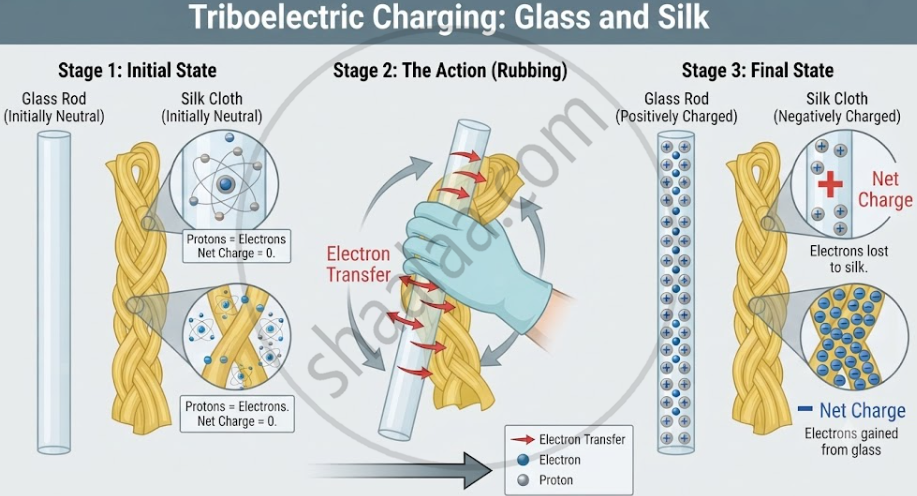
| Classic experiment | Glass rod rubbed with silk | Plastic/ebonite rod rubbed with wool/fur |
| Behaviour | Repels like charges, attracts unlike | Repels like charges, attracts unlike |
Golden Rule: Like charges repel; unlike charges attract.
Maharashtra State Board: Class 11
CISCE: Class 10
Tamil Nadu Board of Secondary Education: Class 8
Properties of Electric Charge
- Charge is a scalar quantity (adds algebraically, not vectorially)
- Charge is conserved — total charge of an isolated system remains constant
- Charge is quantized — it exists only in integral multiples of the elementary charge
- Charge is additive — net charge of a system is the algebraic sum of all individual charges
- Charge is invariant — does not change with the speed of the charged particle (unlike mass)
Tamil Nadu Board of Secondary Education: Class 8
Elementary Charge
- The smallest amount of charge that can exist freely is called the elementary charge (e).
- Its value is 1.602 × 10⁻¹⁹ C — this is the charge on each proton and electron.
- Protons carry positive elementary charge (+e), and electrons carry negative elementary charge (−e).
- Since protons and electrons are equal in number, an atom is electrically neutral.
Maharashtra State Board: Class 7
CISCE: Class 10
Tamil Nadu Board of Secondary Education: Class 8, 9
National Testing Agency: Class 12
Electric Charges Inside an Atom
- Every atom has a nucleus with positively charged protons and neutral neutrons, surrounded by negatively charged electrons.
- If an electron is removed from an atom, it becomes a positive ion.
- If an electron is added to an atom, it becomes a negative ion.
- When a plastic comb is rubbed on dry hair, electrons transfer from hair to the comb — hair becomes positive, the comb becomes negative.
Tamil Nadu Board of Secondary Education: Class 8, 9
National Testing Agency: Class 12
Measuring Electric Charge
- The unit of charge is coulomb (C); the charge of an electron is e = 1.6 × 10⁻¹⁹ C.
- Any charge q must be an integer multiple of e: q = ne, where nn is a whole number.
- One coulomb contains 6.25 × 10¹⁸ electrons.
- Practical sub-units: 1 µC = 10−6 C, 1 nC = 10−9 C, 1 pC = 10−12 C.
Conservation and Additivity of Charge
- Law of Conservation of Charge: Charge can neither be created nor destroyed; it can only be transferred from one body to another.
- Additivity: If a system has charges q1, q2, q3, ... qn, the total charge is:
Q = q1 + q2 + q3 + ... +qn
Analogy: Think of charge like money in a closed economy — it only moves between accounts (bodies); no new "charge currency" is printed or destroyed.
CISCE: Class 10, 12
Concept of Charge (Conductors & Insulators)
- When two non-conducting bodies are rubbed, electrons transfer — the body gaining electrons becomes negatively charged, the body losing electrons becomes positively charged.
- The SI unit of charge is coulomb (C); smaller units are milli-coulomb (mC = 10−3 C), micro-coulomb (µC = 10−6 C), nano-coulomb (nC = 10−9 C).
- Charge on a body is always q = ±ne, an integer multiple of the electron charge.
- In an insulator, charge stays static at the point of excess or deficit of electrons — it does not flow.
- In a conductor, free electrons can move and flow throughout the entire volume.
CISCE: Class 12
Charging by Induction
- When an uncharged conductor is brought near a charged body (without contact), the nearer side develops opposite charge and the far side develops similar charge — this is called induction.
- In induction, no charge is transferred between the charged body and the conductor.
- When the charged body is removed, the charges in the conductor redistribute freely again.
| Method | Process | Contact Required? | Result |
| Friction | Rubbing two neutral bodies together | Yes | Both bodies get opposite charges |
| Conduction | Charged body touches neutral body | Yes | Neutral body gets same charge as source |
| Induction | Charged body brought near (not touching) a neutral conductor | No | Near side gets opposite charge, far side gets same charge |
CISCE: Class 12
Historical Background & Electrostatics
- Term "electricity" derived from Greek word elektron (amber), as amber attracted light objects when rubbed
- Benjamin Franklin introduced the convention of naming charges "positive" and "negative"
- Charles Coulomb later quantified the force between charges (Coulomb's Law)
Conductors vs Insulators
| Feature | Conductors | Insulators |
|---|---|---|
| Free electrons | Abundant | Very few / none |
| Charge flow | Easy | Difficult/Not possible |
| Examples | Copper, silver, aluminium | Rubber, glass, plastic |
| Use in charging | Charge spreads over surface | Charge stays localized |
Video Tutorials
Shaalaa.com | Electric Charges and Fields part 1 (Introduction)
Series: 1
00:04:44 undefined
00:12:02 undefined
00:18:48 undefined
00:05:41 undefined
00:08:43 undefined
00:06:38 undefined
00:12:41 undefined
00:02:36 undefined
