ISC (Science)
Academic Year: 2019-2020
Date: मार्च 2020
Advertisements
- All questions are compulsory.
- This question paper is divided into 4 Sections, A, B, C, and D as follows:
- Section A: Question number 1 is of twelve marks. All parts of this question are compulsory.
- Section B: Question numbers 2 to 12 carry 2 marks each, with two questions having internal choice.
- Section C: Question numbers 13 to 19 carry 3 marks each, with two questions having internal choice.
- Section D: Question numbers 20 to 22 are long-answer type questions and carry 5 marks each.
- Each question has an internal choice.
- The intended marks for questions are given in brackets [ ].
- All working, including rough work, should be done on the same sheet as and adjacent to the rest of the answer.
- Answers to sub parts of the same question must be given in one place only. A list of useful physical constants is given at the end of this paper.
- A simple scientific calculator without a programmable memory may be used for calculations.
Useful Constant and Relation:
| 1 u | = | 931 MeV |
A point charge ‘q’ is kept at each of the vertices of an equilateral triangle having each side ‘a’. Total electrostatic potential energy of the system is ______.
`(1/(4 pi epsilon_0)) (3 q^2)/a^2`
`(1/(4 pi epsilon_0)) (3 q)/a`
`(1/(4 pi epsilon_0)) (3 q^2)/a`
`(1/(4 pi epsilon_0)) (3 q)/a^2`
Chapter:
Curie temperature is the temperature above which ______.
a ferromagnetic substance behaves like a paramagnetic substance.
a paramagnetic substance behaves like a diamagnetic substance.
a ferromagnetic substance behaves like a diamagnetic substance.
a paramagnetic substance behaves like a ferromagnetic substance.
Chapter:
In an astronomical telescope of refracting type ______.
Objective should have small focal length.
Objective should have large focal length.
Eyepiece should have large focal length.
Both objective and eyepiece should have large focal length.
Chapter:
In photoelectric effect experiment, the slope of the graph of the stopping potential versus frequency gives the value of ______.
`h/e`
h
`e/h`
`(hc)/e`
Chapter:
In a nuclear reactor, cadmium rods are used as ______.
Control rods
Fuel rods
Coolant
Moderator
Chapter:
State Gauss’ Law.
Chapter: [1] Electric Charges and Fields
Answer the following question briefly and to the point:
A metallic wire having a resistance of 20 Ω is bent in order to form a complete circle. Calculate the resistance between any two diametrically opposite points on the circle.
Chapter:
Answer the following question briefly and to the point:
How can a moving coil galvanometer be converted into a voltmeter
Chapter:
Answer the following question briefly and to the point:
What is the phase difference between any two points lying on the same wavefront?
Chapter: [10] Wave Optics
Name the principle on the basis of which optical fibres work.
Chapter: [9] Ray Optics and Optical Instruments
A uniform copper wire having a cross sectional area of 1 mm2 carries a current of 5 A. Calculate the drift speed of free electrons in it.
(Free electron number density of copper = 2 × 1028/m3.)
Chapter:
An electric bulb is rated as 250 V, 750 W. Calculate the:
- Electric current flowing through it, when it is operated on a 250 V supply.
- Resistance of its filament.
Chapter:
Write an expression for force per unit length between two long current carrying wires, kept parallel to each other, in vacuum and hence define an ampere, the SI unit of current.
Chapter:
State the relation between magnetic susceptibility (χ) and relative permeability (μr) of a magnetic substance.
Chapter:
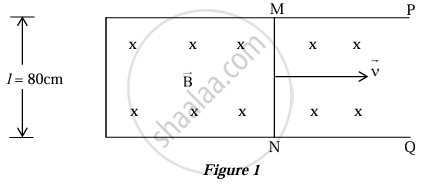
Figure 1 below shows a metallic rod MN of length l = 80 cm, kept in a uniform magnetic field of flux density B = 0.5 T, on two parallel metallic rails P and Q. Calculate the emf that will be induced between its two ends, when it is moved towards right with a constant velocity v of 36 km/hr.
Chapter:
Advertisements
When current flowing through one coil changes from 0 Amp to 15 Amp in 0.2 s, an emf of 750 V is induced in an adjacent coil. Calculate the coefficient of mutual inductance of the two coils.
Chapter:
Name two sources of ultraviolet radiation.
Chapter: [8] Electromagnetic Waves
Where will you keep an object in front of a convex lens in order to get a virtual and magnified image?
Chapter:
Where will you keep an object in front of a concave mirror to get a real and diminished image?
Chapter:
Draw a labelled graph of angle of deviation (𝛿) versus angle of incidence (i) for a prism.
Chapter:
State de Broglie hypothesis.
Chapter: [11] Dual Nature of Radiation and Matter
What conclusion can be drawn from Davisson and Germer’s experiment?
Chapter:
Calculate binding energy of oxygen nucleus \[\ce{(^16_8O)}\] from the data given below:
Mass of a proton = 1.007825 u
Mass of a neutron = 1.008665 u
Mass of \[\ce{(^16_8O)}\] = 15.994915 u
Chapter:
For a radioactive substance, write the relation between half life (T) and disintegration constant (λ).
Chapter:
For a radioactive substance, write the relation between Mean life (τ) and disintegration constant (λ).
Chapter:
In a communication system, what is meant by modulation?
Chapter:
Explain the term demodulation used in a communication system.
Chapter:
Show that intensity of electric field at a point in broadside position of an electric dipole is given by:
E = `(1/(4 pi epsilon_0)) p/((r^2 + l^2)^(3//2))`
Where the terms have their usual meaning.
Chapter: [1] Electric Charges and Fields
A parallel plate capacitor is charged by a battery, which is then disconnected. A dielectric slab having dielectric constant (relative permittivity) K, is now introduced between its two plates in order to occupy the space completely.
State, in terms of K, its effect on the following:
- The capacitance of the capacitor.
- The potential difference between its plates
- The energy stored in the capacitor.
Chapter:
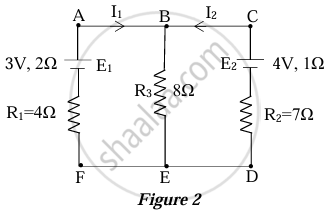
E1 and E2 are two batteries having emfs of 3 V and 4 V and internal resistances of 2 Ω and 1 Ω respectively. They are connected as shown in Figure 2 below. Using Kirchhoff’s Laws of electrical circuits, calculate the currents I1 and I2.
Chapter:
A potentiometer circuit is shown in Figure 3 below. AB is a uniform metallic wire having length of 2 m and resistance of 8 Ω. The batteries E1 and E2 have emfs of 4 V and 1.5 V and their internal resistances are 1 Ω and 2 Ω respectively.
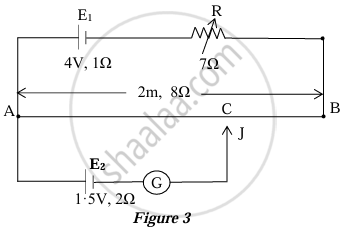
- When the jockey J does not touch the wire AB, calculate:
- the current flowing through the potentiometer wire AB.
- the potential gradient across the wire AB.
- Now the jockey J is made to touch the wire AB at a point C such that the galvanometer (G) shows no deflection. Calculate the length AC.
Chapter:
When two thin lenses are kept in contact, prove that their combined or effective focal length F is given by:
`1/F = 1/f_1 + 1/f_2`
where the terms have their usual meaning.
Chapter:
A compound microscope consists of two convex lenses having focal length of 1.5 cm and 5 cm. When an object is kept at a distance of 1.6 cm from the objective, the final image is virtual and lies at a distance of 25 cm from the eyepiece. Calculate magnifying power of the compound microscope in this set-up.
Chapter:
Advertisements
In Young’s double slit experiment, the screen is kept at a distance of 1.2 m from the plane of the slits. The two slits are separated by 5 mm and illuminated with monochromatic light having wavelength 600 nm. Calculate:
- Fringe width i.e. fringe separation of the interference pattern.
- Distance of 10th bright fringe from the centre of the pattern.
Chapter:
Draw the energy level diagram of hydrogen atom and show the transitions responsible for:
- absorption lines of Lyman series.
- emission lines of Balmer series.
Chapter:
State any one difference between the energy band diagram of conductors and that of insulators.
Chapter:
Give a relation between α and β for a transistor.
(Derivation is not required.)
Chapter:
What is the advantage of an LED bulb over the filament electric bulb?
Chapter:
A 400 Ω resistor, a 3 H inductor and a 5 µF capacitor are connected in series to a 220 V, 50 Hz ac source. Calculate the:
- Impedance of the circuit.
- Current flowing through the circuit.
Chapter:
Draw a labelled graph showing the variation of impedance (Z) of a series LCR circuit versus frequency (f) of the ac supply.
Chapter:
When an alternating emf e = 310 sin (100 πt)V is applied to a series LCR circuit, current flowing through it is i = 5 sin(100 πt + π/3)A.
- What is the phase difference between the current and the emf?
- Calculate the average power consumed by the circuit.
Chapter:
Obtain an expression for the resonant frequency (f0) of a series LCR circuit.
Chapter:
Derive an expression for refraction at a single (convex) spherical surface, i.e., a relation between u, v, R, n1 (rarer medium) and n2 (denser medium), where the terms have their usual meaning.
Chapter:
Name the phenomenon due to which the sun appears reddish at sunset.
Chapter:
Draw a labelled graph showing the variation in intensity of diffracted light with diffracting angle in a single slit Fraunhofer diffraction experiment.
Chapter:
How will you distinguish experimentally between ordinary light and plane polarized light?
Chapter:
In a semiconductor diode, what is meant by potential barrier?
Chapter:
Draw a labelled circuit diagram of a Zener diode as a voltage regulator.
Chapter:
Show with the help of a diagram, how you will obtain an AND gate using only NAND gates. (Truth table is not required.)
Chapter:
Draw a neat labelled circuit diagram for transistors as common emitter amplifiers.
Chapter:
Draw the symbol of a NAND gate and write its truth table.
Chapter:
Other Solutions
Submit Question Paper
Help us maintain new question papers on Shaalaa.com, so we can continue to help studentsonly jpg, png and pdf files
CISCE previous year question papers ISC Class 12 Physics (Theory) with solutions 2019 - 2020
Previous year Question paper for CISCE ISC Class 12 -2020 is solved by experts. Solved question papers gives you the chance to check yourself after your mock test.
By referring the question paper Solutions for Physics (Theory), you can scale your preparation level and work on your weak areas. It will also help the candidates in developing the time-management skills. Practice makes perfect, and there is no better way to practice than to attempt previous year question paper solutions of CISCE ISC Class 12.
How CISCE ISC Class 12 Question Paper solutions Help Students ?
• Question paper solutions for Physics (Theory) will helps students to prepare for exam.
• Question paper with answer will boost students confidence in exam time and also give you an idea About the important questions and topics to be prepared for the board exam.
• For finding solution of question papers no need to refer so multiple sources like textbook or guides.
