Advertisements
Advertisements
प्रश्न
When two thin lenses are kept in contact, prove that their combined or effective focal length F is given by:
`1/F = 1/f_1 + 1/f_2`
where the terms have their usual meaning.
For two thin lenses kept in contact with each other, show that:
`1/F = 1/f_1 + 1/f_2`
where the terms have their usual meaning.
Advertisements
उत्तर १

(1) The image is formed in two steps:
In the first step, the lens L1 produces the image I' of the object A. It is a real image at a distance v' from L1.
Then for the lens L1, we have,
`1/(v') + 1/(-u) = 1/f_1`
∴ `1/(v') - 1/u = 1/f_1` ...(i)
(2) In the second step, the image I' acts as an object for L2 and the final image I is formed. The image I' is not observed, hence it acts as a virtual object for lens L2; it is assumed to be kept on the left, we can write for L2.
`1/v + 1/(-v') = 1/f_2`
∴ `1/v - 1/(v') = 1/f_2` ...(ii)
(3) Adding equations (i) and (ii), we get
`1/(v') - 1/u + 1/v - 1/(v') = 1/f_1 + 1/f_2`
`:. 1/v - 1/u = 1/f_1 + 1/f_2` ....(iii)
(4) If a single lens of focal length (F) of an equivalent lens is used for object A and a corresponding image (I) is formed, then we have,
`1/v + 1/(-u) = 1/F` ...(iv)
(5) From equations (iii) and (iv),
`1/F = 1/f_1 + 1/f_2` ...(v)
उत्तर २
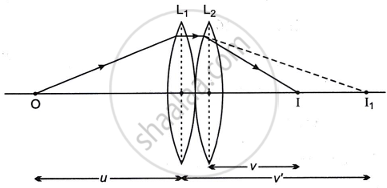
Combined focal length of two thin lenses in contact, both lenses are convex: Suppose two thin convex lenses L1 and L2 of focal lengths f1 and f2 are placed in contact in air, having a common principal axis. A point-object O is placed on the principal axis at a distance u from the first lens L1. Its image would be formed by the lens L1 alone at I1 distant v' (say) from L1. Then, from the lens formula, we have:
`1/(v') - 1/u = 1/f_1` ...(i)
I' serves as a virtual object for the second lens L2 which forms a final image I at a distance v (say) from it.
Then, we have:
`1/v - 1/(v') = 1/f_2` ...(ii)
Adding equations (i) and (ii), we get,
`1/v - 1/u = 1/f_1 + 1/f_2` ...(iii)
If we replace these two lenses with a single lens which forms the image of an object distant u from it at a distance v, then the focal length F of this equivalent lens would be given by,
`1/v - 1/u = 1/F` ...(iv)
From equations (iii) and (iv), we get,
`1/F = 1/f_1 + 1/f_2` ...(v)
