Advertisements
Advertisements
Question
An air-filled parallel-plate capacitor is to be constructed which can store 12 µC of charge when operated at 1200 V. What can be the minimum plate area of the capacitor? The dielectric strength of air is `3 xx 10^6 "Vm"^-1`
Advertisements
Solution
Charge that the capacitor can hold = 12 μC
Operating voltage = 1200 V
Breakdown strength, b = `3 xx 10^6 "Vm"^-1`
The separation between the plates of the capacitor is given by `d = V/b = 1200/(3 xx 10^6) = 4 xx 10^-4 "m"`
The capacitance of the capacitor is given by `C = Q/V = (12 xx 10^-6)/1200 = 10^-8 "F"`
The capacitance can be expressed in terms of the area of the plates (A) and the separation of the plates (d) as : `C = (∈_0A)/d = 10^-8 "F"`
Thus, the area of the plates is given by
`A = (10^-8 xx (4 xx 10^-4))/(8.854 xx 10^-12) = 0.45 "m"^2`
APPEARS IN
RELATED QUESTIONS
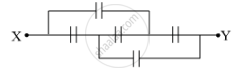
Find the equivalent capacitance of the network shown in the figure, when each capacitor is of 1 μF. When the ends X and Y are connected to a 6 V battery, find out (i) the charge and (ii) the energy stored in the network.
Define capacitor reactance. Write its S.I units.
A spherical capacitor has an inner sphere of radius 12 cm and an outer sphere of radius 13 cm. The outer sphere is earthed and the inner sphere is given a charge of 2.5 µC. The space between the concentric spheres is filled with a liquid of dielectric constant 32.
(a) Determine the capacitance of the capacitor.
(b) What is the potential of the inner sphere?
(c) Compare the capacitance of this capacitor with that of an isolated sphere of radius 12 cm. Explain why the latter is much smaller.
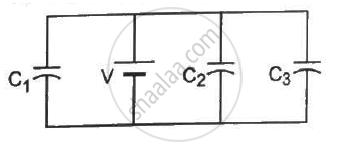
Find the charges on the three capacitors connected to a battery as shown in figure.
Take `C_1 = 2.0 uF , C_2 = 4.0 uF , C_3 = 6.0 uF and V` = 12 volts.
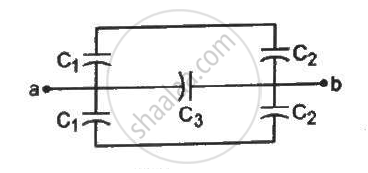
Find the equivalent capacitance of the system shown in figure between the points a and b.
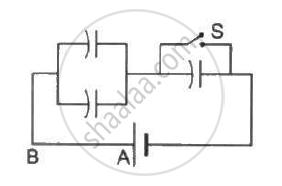
Each capacitor shown in figure has a capacitance of 5⋅0 µF. The emf of the battery is 50 V. How much charge will flow through AB if the switch S is closed?
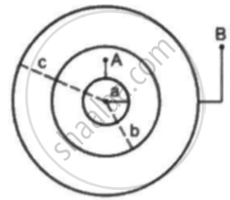
Suppose the space between the two inner shells is filled with a dielectric of dielectric constant K. Find the capacitance of the system between A and B.
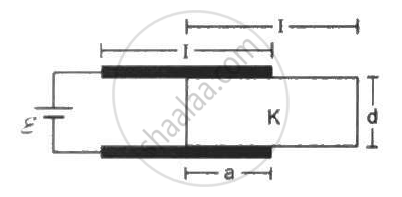
Consider the situation shown in figure. The plates of the capacitor have plate area A and are clamped in the laboratory. The dielectric slab is released from rest with a length a inside the capacitor. Neglecting any effect of friction or gravity, show that the slab will execute periodic motion and find its time period.
A parallel plate capacitor stores a charge Q at a voltage V. Suppose the area of the parallel plate capacitor and the distance between the plates are each doubled then which is the quantity that will change?
Explain in detail the effect of a dielectric placed in a parallel plate capacitor.
During a thunder storm, the movement of water molecules within the clouds creates friction, partially causing the bottom part of the clouds to become negatively charged. This implies that the bottom of the cloud and the ground act as a parallel plate capacitor. If the electric field between the cloud and ground exceeds the dielectric breakdown of the air (3 × 10⁶ Vm–1), lightning will occur.
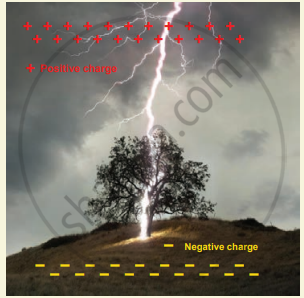
- If the bottom part of the cloud is 1000 m above the ground, determine the electric potential difference that exists between the cloud and ground.
- In a typical lightning phenomenon, around 25 C of electrons are transferred from cloud to ground. How much electrostatic potential energy is transferred to the ground?
- Charge on each capacitor remains same and equals to the main charge supplied by the battery.
- Potential difference and energy distribute in the reverse ratio of capacitance.
- Effective capacitance is even les than the least of teh individual capacitances.
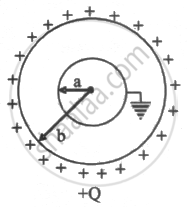
Two spherical conductors A and B of radii a and b(b > a) are placed concentrically in the air. B is given a charge +Q and A is earthed. The equivalent capacitance of the system is ______.
The radius of a sphere of capacity 1 microfarad in the air is ______
A capacitor of capacity 2 µF is charged to a potential difference of 12 V. It is then connected across an inductor of inductance 0.6 mH. The current in the circuit at a time when the potential difference across the capacitor is 6.0 V is ______ × 10-1A.
What is the SI unit of capacitance?
In a series combination, which statement describes the potential difference across each capacitor?
In a parallel combination, which quantity is the same across each capacitor?
