Advertisements
Advertisements
Question
A parallel-plate capacitor has plate area 25⋅0 cm2 and a separation of 2⋅00 mm between the plates. The capacitor is connected to a battery of 12⋅0 V. (a) Find the charge on the capacitor. (b) The plate separation is decreased to 1⋅00 mm. Find the extra charge given by the battery to the positive plate.
Advertisements
Solution
Given :
Area of the plate , `A = 25 "cm"^2 = 25 xx 10^-4 "m"^2`
Separation between the plates, `d = 2 "mm" = 2 xx 10^-3 "m"`
Potential difference between the plates, V = 12 V
The capacitance of the given capacitor is given by
`C = (∈_0A)/d`
= `((8.85 xx 10^-12) xx (25 xx 10^-4))/((2 xx 10^-3))`
= `11.06 xx 10^-12 "F"`
(a) Charge on the capacitor is given by
Q = CV
= `11.06 xx 10^-12 xx 12`
= `1.33 xx 10^-10 "C"`
(b) When the separation between the plates is decreased to 1 mm , the capacitance `C^'` can be calculated as :
`C^' = (∈_0A)/d`
= `((8.85 xx 10^-12) xx (25 xx 10^-4))/(1 xx 10^-3)`
= `22.12 xx 10^-12 "F"`
Charge on the capacitor is given by
`Q^' = C^'V`
= `22.12 xx 10^-12 xx 12`
= `2.65 xx 10^-10 "C"`
Extra Charge
= `(2.65 xx 10^-10 - 1.32 xx 10^-10) C`
= `1.33 xx 10^-10 "C"`
APPEARS IN
RELATED QUESTIONS
A capacitor has capacitance C. Is this information sufficient to know what maximum charge the capacitor can contain? If yes, what is this charges? If no, what other information is needed?
A capacitor of capacitance C is charged to a potential V. The flux of the electric field through a closed surface enclosing the capacitor is
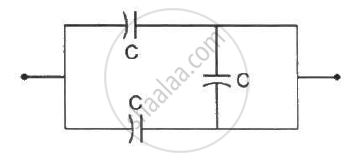
The equivalent capacitance of the combination shown in the figure is _________ .
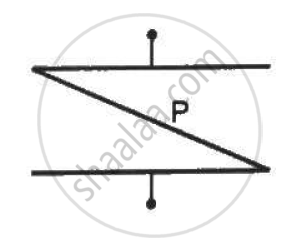
A thin metal plate P is inserted between the plates of a parallel-plate capacitor of capacitance C in such a way that its edges touch the two plates . The capacitance now becomes _________ .
Three capacitors having capacitances 20 µF, 30 µF and 40 µF are connected in series with a 12 V battery. Find the charge on each of the capacitors. How much work has been done by the battery in charging the capacitors?
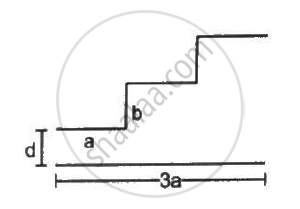
A capacitor is made of a flat plate of area A and a second plate having a stair-like structure as shown in figure . The width of each stair is a and the height is b. Find the capacitance of the assembly.
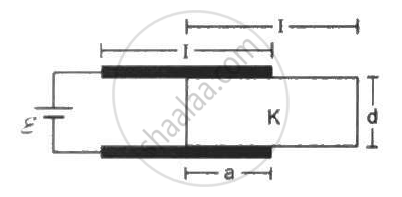
Consider the situation shown in figure. The plates of the capacitor have plate area A and are clamped in the laboratory. The dielectric slab is released from rest with a length a inside the capacitor. Neglecting any effect of friction or gravity, show that the slab will execute periodic motion and find its time period.
You are provided with 8 μF capacitors. Show with the help of a diagram how you will arrange minimum number of them to get a resultant capacitance of 20 μF.
A parallel plate capacitor stores a charge Q at a voltage V. Suppose the area of the parallel plate capacitor and the distance between the plates are each doubled then which is the quantity that will change?
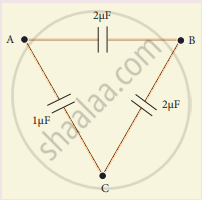
Three capacitors are connected in a triangle as shown in the figure. The equivalent capacitance between points A and C is ______.
Derive the expression for resultant capacitance, when the capacitor is connected in series.
- Charge on each capacitor remains same and equals to the main charge supplied by the battery.
- Potential difference and energy distribute in the reverse ratio of capacitance.
- Effective capacitance is even les than the least of teh individual capacitances.
Can the potential function have a maximum or minimum in free space?
A leaky parallel plate capacitor is filled completely with a material having dielectric constant K = 5 and electric conductivity σ = 7.4 × 10⁻¹² Ω-1 m-1. If the charge on the plate at the instant t = 0 is q = 8.85 µC, then the leakage current at the instant t = 12 s is ______ × 10-1 µA.
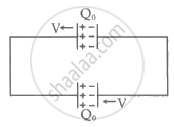
Two identical capacitors are connected as shown and have an initial charge of Q0. The separation between the plates of each capacitor is d0. Suddenly the left plate of the upper capacitor and right plate of the lower capacitor start moving with speed v towards the left while the other plate of each capacitor remains fixed. `("given" (Q_0V)/(2d_0) = 10 A)`. The value of current in the circuit is ______ A.
What is called the capacity of conductor?
For the same potential difference, what does a larger capacitance mean?
For a given capacitor, what fixes its capacitance?
In a parallel combination, which statement describes the charges on the capacitors?
What is the practical purpose of a parallel combination of capacitors?
