Advertisements
Advertisements
प्रश्न
A parallel-plate capacitor has plate area 25⋅0 cm2 and a separation of 2⋅00 mm between the plates. The capacitor is connected to a battery of 12⋅0 V. (a) Find the charge on the capacitor. (b) The plate separation is decreased to 1⋅00 mm. Find the extra charge given by the battery to the positive plate.
Advertisements
उत्तर
Given :
Area of the plate , `A = 25 "cm"^2 = 25 xx 10^-4 "m"^2`
Separation between the plates, `d = 2 "mm" = 2 xx 10^-3 "m"`
Potential difference between the plates, V = 12 V
The capacitance of the given capacitor is given by
`C = (∈_0A)/d`
= `((8.85 xx 10^-12) xx (25 xx 10^-4))/((2 xx 10^-3))`
= `11.06 xx 10^-12 "F"`
(a) Charge on the capacitor is given by
Q = CV
= `11.06 xx 10^-12 xx 12`
= `1.33 xx 10^-10 "C"`
(b) When the separation between the plates is decreased to 1 mm , the capacitance `C^'` can be calculated as :
`C^' = (∈_0A)/d`
= `((8.85 xx 10^-12) xx (25 xx 10^-4))/(1 xx 10^-3)`
= `22.12 xx 10^-12 "F"`
Charge on the capacitor is given by
`Q^' = C^'V`
= `22.12 xx 10^-12 xx 12`
= `2.65 xx 10^-10 "C"`
Extra Charge
= `(2.65 xx 10^-10 - 1.32 xx 10^-10) C`
= `1.33 xx 10^-10 "C"`
APPEARS IN
संबंधित प्रश्न
A capacitor of capacitance C is charged fully by connecting it to a battery of emf E. It is then disconnected from the battery. If the separation between the plates of the capacitor is now doubled, how will the following change?
(i) charge stored by the capacitor.
(ii) Field strength between the plates.
(iii) Energy stored by the capacitor.
Justify your answer in each case.
A parallel plate capacitor of capacitance C is charged to a potential V. It is then connected to another uncharged capacitor having the same capacitance. Find out the ratio of the energy stored in the combined system to that stored initially in the single capacitor.
A capacitor of unknown capacitance is connected across a battery of V volts. The charge stored in it is 300 μC. When potential across the capacitor is reduced by 100 V, the charge stored in it becomes 100 μC. Calculate The potential V and the unknown capacitance. What will be the charge stored in the capacitor if the voltage applied had increased by 100 V?
Three capacitors having capacitances 20 µF, 30 µF and 40 µF are connected in series with a 12 V battery. Find the charge on each of the capacitors. How much work has been done by the battery in charging the capacitors?
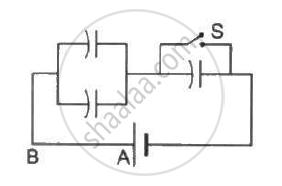
Each capacitor shown in figure has a capacitance of 5⋅0 µF. The emf of the battery is 50 V. How much charge will flow through AB if the switch S is closed?
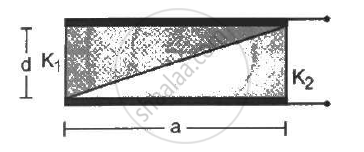
A capacitor is formed by two square metal-plates of edge a, separated by a distance d. Dielectrics of dielectric constant K1 and K2 are filled in the gap as shown in figure . Find the capacitance.
A sphercial capacitor is made of two conducting spherical shells of radii a and b. The space between the shells is filled with a dielectric of dielectric constant K up to a radius c as shown in figure . Calculate the capacitance.
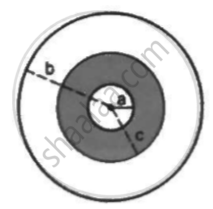
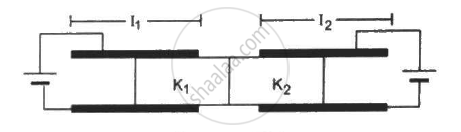
Figure shows two parallel plate capacitors with fixed plates and connected to two batteries. The separation between the plates is the same for the two capacitors. The plates are rectangular in shape with width b and lengths l1 and l2. The left half of the dielectric slab has a dielectric constant K1 and the right half K2. Neglecting any friction, find the ration of the emf of the left battery to that of the right battery for which the dielectric slab may remain in equilibrium.
Three capacitors C1 = 3μF, C2 = 6μF, and C3 = 10μF are connected to a 50 V battery as shown in Figure below:

Calculate:
(i) The equivalent capacitance of the circuit between points A and B.
(ii) The charge on C1.
You are provided with 8 μF capacitors. Show with the help of a diagram how you will arrange minimum number of them to get a resultant capacitance of 20 μF.
The positive terminal of 12 V battery is connected to the ground. Then the negative terminal will be at ______.
When air is replaced by a dielectric medium of constant K, the maximum force of attraction between two charges separated by a distance ______.
The capacitance of a parallel plate capacitor is 60 µF. If the distance between the plates is tripled and area doubled then new capacitance will be ______.
Between the plates of parallel plate condenser there is 1 mm thick medium shoot of dielectric constant 4. It is charged at 100 volt. The electric field in volt/meter between the plates of capacitor is ______.
Two similar conducting spheres having charge+ q and -q are placed at 'd' seperation from each other in air. The radius of each ball is r and the separation between their centre is d (d >> r). Calculate the capacitance of the two ball system ______.

Two spherical conductors of capacities 4 µF and 3 µF are charged to same potential having radii 4 cm and 3 cm respectively. If ‘σ1’ and ‘σ2’ represent surface density of charge on respective conductors then ______.
For the same potential difference, what does a larger capacitance mean?
What does a large capacitance mean in terms of charge storage and potential difference?
For a given capacitor, what fixes its capacitance?
