Advertisements
Advertisements
प्रश्न
A parallel-plate capacitor having plate area 25 cm2 and separation 1⋅00 mm is connected to a battery of 6⋅0 V. Calculate the charge flown through the battery. How much work has been done by the battery during the process?
Advertisements
उत्तर
The capacitance of a parallel-plate capacitor is given by `C = (∈_0A)/d`
Here ,
A = Area of the plate
d = Distance between the parallel plates
Given :
A = 25 cm2 = `25 xx 10^-4 "m"^2`
d = 1.00 mm = `1 xx 10^-3 "m"`
Now ,
`C = (∈_0A)/d` = `(8.85 xx 10^-12 xx 25 xx 10^-4)/(1 xx 10^-3)`
= `2.21 xx 10^-11 "F"`
When the battery of voltage 6 V is connected to the capacitor, the charge (Q) that flows from the battery is equal to the amount of the charge that the given capacitor can hold.
⇒ Q = CV
⇒ `Q = 2.21 xx 10^-11 xx 6.0`
= `1.33 xx 10^-10 "C"`
The work done by the battery in charging the capacitor is calculated by taking the product of the magnitude of the charge transferred and the voltage of the battery.
Thus, we get
`W = QV`
= `1.33 xx 10^-10 xx 6.0`
= `8.0 xx 10^-10 J`
Thus , the charge flown through the battery is `1.33 xx 10^-10 "C"` and the work done by the battery is `8.0 xx 10^-10 "J"` .
APPEARS IN
संबंधित प्रश्न
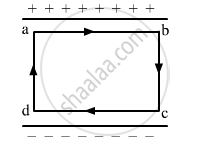
The electric field inside a parallel plate capacitor is E. Find the amount of work done in moving a charge q over a closed loop a b c d a.
Three capacitors of capacitances 2 pF, 3 pF and 4 pF are connected in parallel. Determine the charge on each capacitor if the combination is connected to a 100 V supply.
An electrical technician requires a capacitance of 2 µF in a circuit across a potential difference of 1 kV. A large number of 1 µF capacitors are available to him each of which can withstand a potential difference of not more than 400 V. Suggest a possible arrangement that requires the minimum number of capacitors.
Suppose a charge +Q1 is given to the positive plate and a charge −Q2 to the negative plate of a capacitor. What is the "charge on the capacitor"?
The plates of a parallel-plate capacitor are given equal positive charges. What will be the potential difference between the plates? What will be the charges on the facing surfaces and on the outer surfaces?
If the capacitors in the previous question are joined in parallel, the capacitance and the breakdown voltage of the combination will be
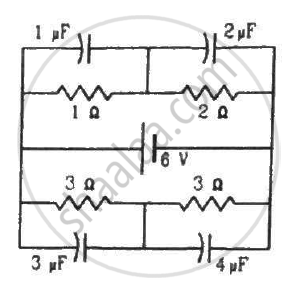
Find the charges on the four capacitors of capacitances 1 μF, 2 μF, 3 μF and 4 μF shown in the figure.
A parallel-plate capacitor having plate area 20 cm2 and separation between the plates 1⋅00 mm is connected to a battery of 12⋅0 V. The plates are pulled apart to increase the separation to 2⋅0 mm. (a) Calculate the charge flown through the circuit during the process. (b) How much energy is absorbed by the battery during the process? (c) Calculate the stored energy in the electric field before and after the process. (d) Using the expression for the force between the plates, find the work done by the person pulling the plates apart. (e) Show and justify that no heat is produced during this transfer of charge as the separation is increased.
A wire of resistance ‘R’ is cut into ‘n’ equal parts. These parts are then connected in parallel with each other. The equivalent resistance of the combination is:
An ac circuit consists of a series combination of circuit elements X and Y. The current is ahead of the voltage in phase by `pi/4`. If element X is a pure resistor of 100 Ω,
(a) name the circuit element Y.
(b) calculate the rms value of current, if rms of voltage is 141 V.
(c) what will happen if the ac source is replaced by a dc source
Two parallel plate capacitors X and Y, have the same area of plates and same separation between plates. X has air and Y with dielectric of constant 2, between its plates. They are connected in series to a battery of 12 V. The ratio of electrostatic energy stored in X and Y is ______.
Three different capacitors are·connected in series. Then:-
The total charge on the system of capacitors C1 = 1 µF, C2 = 2 µF, C3 = 4 µF and C4 = 3 µF connected in parallel is ______. (Assume a battery of 20 V is connected to the combination)
Three capacitors of capacitances 2 pF, 3 pF and 4 pF are connected in parallel. What is the total capacitance of the combination?
The potential difference that must be applied across the series and parallel combination of 4 identical capacitors such that the energy stored in them becomes the same. The ratio of potential difference in series to parallel combination is ______.
What is the charge relationship for capacitors in series?
What is the equivalent capacitance of \[n\] identical capacitors, each with capacitance \[C\], connected in series?
In a series combination, which capacitor has the larger voltage drop?
Which formula gives the equivalent capacitance of capacitors in parallel?
