Advertisements
Advertisements
प्रश्न
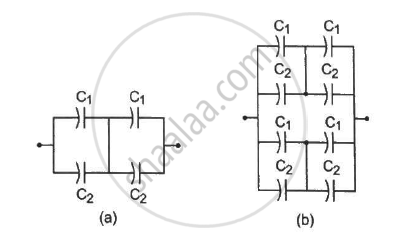
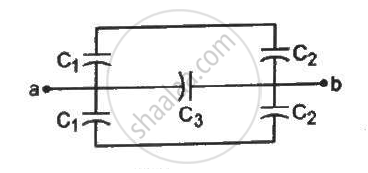
Take `C_1 = 4.0 "uF" and C_2 = 6.0 "uF"` in figure . Calculate the equivalent capacitance of the combination between the points indicated.
Advertisements
उत्तर
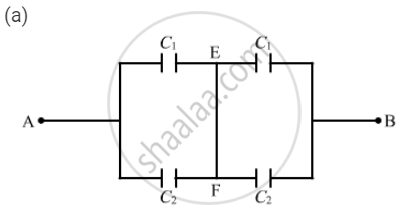
For the combination of capacitors given in figure (a), the pairs of capacitors C1 and C2are in parallel.
The equivalent capacitance of each parallel combination of capacitors is given by
C1 + C2 = 4 + 6 = 10 μF
The equivalent circuit can be drawn as :
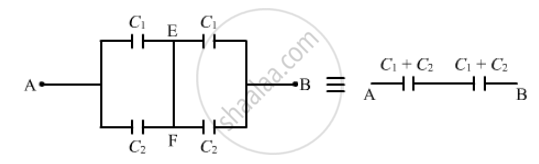
The equivalent capacitance for the above series circuit is given by
`1/C_(eq) = 1/(C_1 + C_2) + 1/(C_1+C_2) = 1/10 + 1/10 = 2/10`
⇒ `C_("eq") = 5 "uF"`
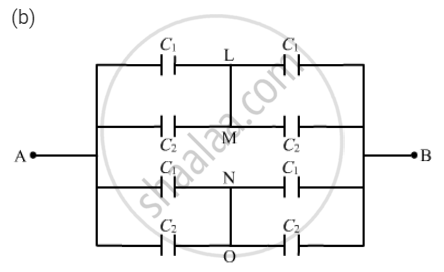
For the combination of capacitors given in figure (b), the pairs of capacitors C1 and C2are in parallel.
The equivalent capacitance of each parallel combination of capacitors is given by
C1 + C2 = 4 + 6 = 10 μF
The equivalent circuit can be drawn as :
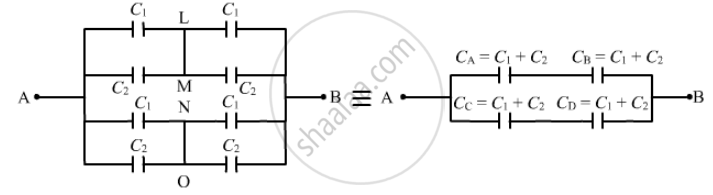
In the above circuit, it can be seen that CA and CB are in series and are in parallel to the series combination of CC and CB.
The equivalent capacitance for the series combination of CA and CB is given by
`1/C_(eq) = 1/C_A + 1/C_B = 1/(C_1+C_2) + 1/(C_1 + C_2)= 1/10 + 1/10 = 1/5`
⇒ `C_(eq) = 5 "uF"`
Similarly, the equivalent capacitance of the series combination of CC and CD is 5 μF.
∴ Net equivalent capacitance = 5 + 5 = 10 μF
APPEARS IN
संबंधित प्रश्न
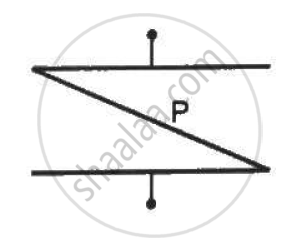
A thin metal plate P is inserted between the plates of a parallel-plate capacitor of capacitance C in such a way that its edges touch the two plates . The capacitance now becomes _________ .
When 1⋅0 × 1012 electrons are transferred from one conductor to another, a potential difference of 10 V appears between the conductors. Calculate the capacitance of the two-conductor system.
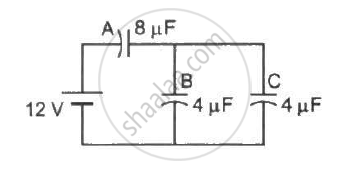
Find the charge appearing on each of the three capacitors shown in figure .
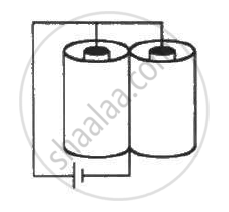
The outer cylinders of two cylindrical capacitors of capacitance 2⋅2 µF each, are kept in contact and the inner cylinders are connected through a wire. A battery of emf 10 V is connected as shown in figure . Find the total charge supplied by the battery to the inner cylinders.
Find the equivalent capacitance of the system shown in figure between the points a and b.
A cylindrical capacitor is constructed using two coaxial cylinders of the same length 10 cm and of radii 2 mm and 4 mm. (a) Calculate the capacitance. (b) Another capacitor of the same length is constructed with cylinders of radii 4 mm and 8 mm. Calculate the capacitance.
A parallel-plate capacitor of capacitance 5 µF is connected to a battery of emf 6 V. The separation between the plates is 2 mm. (a) Find the charge on the positive plate. (b) Find the electric field between the plates. (c) A dielectric slab of thickness 1 mm and dielectric constant 5 is inserted into the gap to occupy the lower half of it. Find the capacitance of the new combination. (d) How much charge has flown through the battery after the slab is inserted?
A parallel-plate capacitor of plate area A and plate separation d is charged to a potential difference V and then the battery is disconnected. A slab of dielectric constant K is then inserted between the plates of the capacitor so as to fill the space between the plates. Find the work done on the system in the process of inserting the slab.
A parallel-plate capacitor with the plate area 100 cm2 and the separation between the plates 1⋅0 cm is connected across a battery of emf 24 volts. Find the force of attraction between the plates.
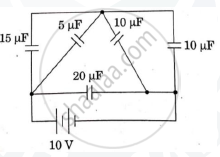
The figure show a network of five capacitors connected to a 10V battery. Calculate the charge acquired by the 5μF capacitor.
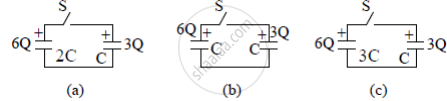
Three circuits, each consisting of a switch 'S' and two capacitors, are initially charged, as shown in the figure. After the switch has been closed, in which circuit will the charge on the left-hand capacitor
(i) increase,
(ii) decrease, and
(iii) remains the same? Give reasons.
The variation of inductive reactance (XL) of an inductor with the frequency (f) of the ac source of 100 V and variable frequency is shown in fig.
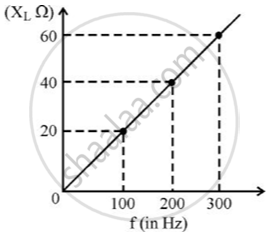
- Calculate the self-inductance of the inductor.
- When this inductor is used in series with a capacitor of unknown value and a resistor of 10 Ω at 300 s–1, maximum power dissipation occurs in the circuit. Calculate the capacitance of the capacitor.
Derive the expression for resultant capacitance, when the capacitor is connected in parallel.
Between the plates of parallel plate condenser there is 1 mm thick medium shoot of dielectric constant 4. It is charged at 100 volt. The electric field in volt/meter between the plates of capacitor is ______.
Calculate equivalent capacitance of the circuit shown in the Figure given below:

For a given capacitor, what fixes its capacitance?
In a series combination, which capacitor gets a larger potential difference?
