Advertisements
Advertisements
प्रश्न
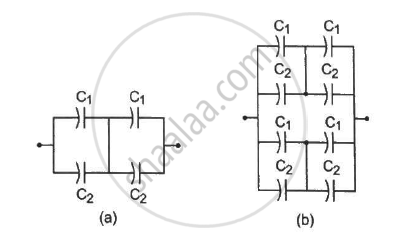
Take `C_1 = 4.0 "uF" and C_2 = 6.0 "uF"` in figure . Calculate the equivalent capacitance of the combination between the points indicated.
Advertisements
उत्तर
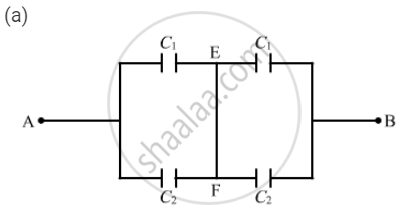
For the combination of capacitors given in figure (a), the pairs of capacitors C1 and C2are in parallel.
The equivalent capacitance of each parallel combination of capacitors is given by
C1 + C2 = 4 + 6 = 10 μF
The equivalent circuit can be drawn as :
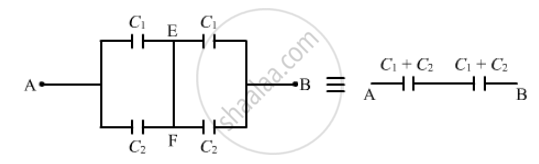
The equivalent capacitance for the above series circuit is given by
`1/C_(eq) = 1/(C_1 + C_2) + 1/(C_1+C_2) = 1/10 + 1/10 = 2/10`
⇒ `C_("eq") = 5 "uF"`
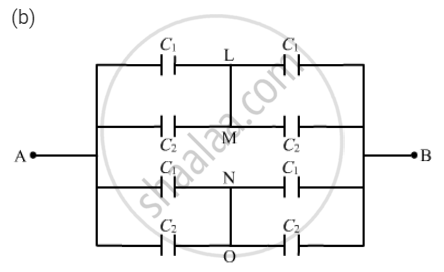
For the combination of capacitors given in figure (b), the pairs of capacitors C1 and C2are in parallel.
The equivalent capacitance of each parallel combination of capacitors is given by
C1 + C2 = 4 + 6 = 10 μF
The equivalent circuit can be drawn as :
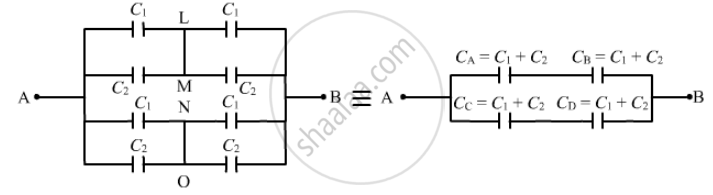
In the above circuit, it can be seen that CA and CB are in series and are in parallel to the series combination of CC and CB.
The equivalent capacitance for the series combination of CA and CB is given by
`1/C_(eq) = 1/C_A + 1/C_B = 1/(C_1+C_2) + 1/(C_1 + C_2)= 1/10 + 1/10 = 1/5`
⇒ `C_(eq) = 5 "uF"`
Similarly, the equivalent capacitance of the series combination of CC and CD is 5 μF.
∴ Net equivalent capacitance = 5 + 5 = 10 μF
APPEARS IN
संबंधित प्रश्न
A spherical capacitor has an inner sphere of radius 12 cm and an outer sphere of radius 13 cm. The outer sphere is earthed and the inner sphere is given a charge of 2.5 µC. The space between the concentric spheres is filled with a liquid of dielectric constant 32.
(a) Determine the capacitance of the capacitor.
(b) What is the potential of the inner sphere?
(c) Compare the capacitance of this capacitor with that of an isolated sphere of radius 12 cm. Explain why the latter is much smaller.
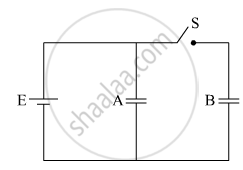
Two identical parallel plate capacitors A and B are connected to a battery of V volts with the switch S closed. The switch is now opened and the free space between the plates of the capacitors is filled with a dielectric of dielectric constant K. Find the ratio of the total electrostatic energy stored in both capacitors before and after the introduction of the dielectric.
Two identical capacitors of 12 pF each are connected in series across a battery of 50 V. How much electrostatic energy is stored in the combination? If these were connected in parallel across the same battery, how much energy will be stored in the combination now?
Also find the charge drawn from the battery in each case.
A capacitor of capacitance ‘C’ is being charged by connecting it across a dc source along with an ammeter. Will the ammeter show a momentary deflection during the process of charging? If so, how would you explain this momentary deflection and the resulting continuity of current in the circuit? Write the expression for the current inside the capacitor.
As `C = (1/V) Q` , can you say that the capacitance C is proportional to the charge Q?
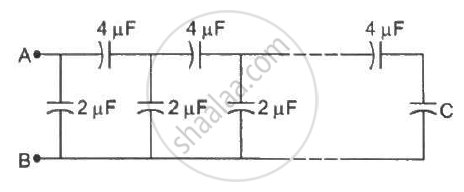
A finite ladder is constructed by connecting several sections of 2 µF, 4 µF capacitor combinations as shown in the figure. It is terminated by a capacitor of capacitance C. What value should be chosen for C, such that the equivalent capacitance of the ladder between the points A and B becomes independent of the number of sections in between?
Each of the plates shown in figure has surface area `(96/∈_0) xx 10^-12` Fm on one side and the separation between the consecutive plates is 4⋅0 mm. The emf of the battery connected is 10 volts. Find the magnitude of the charge supplied by the battery to each of the plates connected to it.
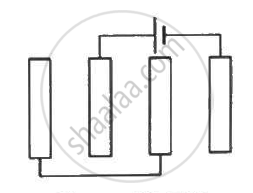
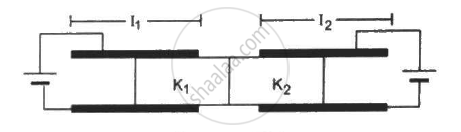
Figure shows two parallel plate capacitors with fixed plates and connected to two batteries. The separation between the plates is the same for the two capacitors. The plates are rectangular in shape with width b and lengths l1 and l2. The left half of the dielectric slab has a dielectric constant K1 and the right half K2. Neglecting any friction, find the ration of the emf of the left battery to that of the right battery for which the dielectric slab may remain in equilibrium.
A capacitor is charged by a battery. The battery is removed and another identical uncharged capacitor is connected in parallel. The total electrostatic energy of resulting system ______.
- Charge on each capacitor remains same and equals to the main charge supplied by the battery.
- Potential difference and energy distribute in the reverse ratio of capacitance.
- Effective capacitance is even les than the least of teh individual capacitances.
Three capacitors 2µF, 3µF, and 6µF are joined in series with each other. The equivalent capacitance is ____________.
Two similar conducting spheres having charge+ q and -q are placed at 'd' seperation from each other in air. The radius of each ball is r and the separation between their centre is d (d >> r). Calculate the capacitance of the two ball system ______.

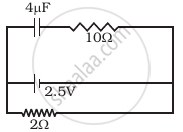
A capacitor of 4 µ F is connected as shown in the circuit (Figure). The internal resistance of the battery is 0.5 Ω. The amount of charge on the capacitor plates will be ______.
A capacitor has charge 50 µC. When the gap between the plate is filled with glass wool, then 120 µC charge flows through the battery to capacitor. The dielectric constant of glass wool is ______.
Obtain the equivalent capacitance of the network shown in the figure. For a 300 V supply, determine the charge on each capacitor.

If the plates of a parallel plate capacitor connected to a battery are moved close to each other, then:
- the charge stored in it. increases.
- the energy stored in it, decreases.
- its capacitance increases.
- the ratio of charge to its potential remains the same.
- the product of charge and voltage increases.
Choose the most appropriate answer from the options given below:
Which system is called a capacitor?
For the same potential difference, what does a larger capacitance mean?
Which set lists the factors on which capacitance depends?
What is the SI unit of capacitance?
