Advertisements
Advertisements
प्रश्न
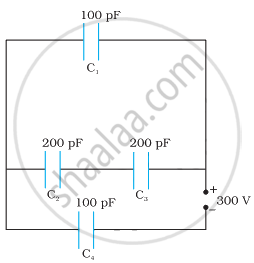
Obtain the equivalent capacitance of the network in Figure. For a 300 V supply, determine the charge and voltage across each capacitor.
Advertisements
उत्तर
Capacitance of capacitor C1 is 100 pF.
Capacitance of capacitor C2 is 200 pF.
Capacitance of capacitor C3 is 200 pF.
Capacitance of capacitor C4 is 100 pF.
Supply potential, V = 300 V
Capacitors C2 and C3 are connected in series.
Let their equivalent capacitance be C'
∴ `1/"C'" = 1/200 + 1/200 = 2/200`
∴ C' = 100 pF
Capacitors C1 and C' are in parallel. Let their equivalent capacitance be C''.
∴ `"C''" = "C'" + "C"_1`
= 100 + 100
= 200 pF
C'' and C4 are connected in series. Let their equivalent capacitance be C.
∴ `1/C = 1/("C''") + 1/("C"_4)`
= `1/200 + 1/100`
= `(2 + 1)/200`
C = `200/3` pF
Hence, the equivalent capacitance of the circuit is `200/3` pF.
Potential difference across C" = V"
Potential difference across C4 = V4
∴ `"V''" + "V"_4 = "V" = 300 "V"`
Charge on C4 is given by
Q4 = CV
= `200/3 xx 10^-12 xx 300`
= `2 xx 10^-8 "C"`
∴ `"V"_4 = "Q"_4/"C"_4`
= `(2 xx 10^-8)/(100 xx 10^-12)` = 200 V
∴ Voltage across C1 is given by
`"V"_1 = "V" - "V"_4`
= `300 - 200 = 100 "V"`
Hence, potential difference, V1, across C1 is 100 V.
Charge on C1 is given by,
`"Q"_1 = "C"_1"V"_1`
= `100 xx 10^-12 xx 100`
= `10^-8 "C"`
C2 and C3 have the same capacitances have a potential difference of 100 V together. Since C2 and C3 are in series, the potential difference across C2 and C3 is given by,
V2 = V3 = 50 V
Therefore, charge on C2 is given by,
`"Q"_2 = "C"_2"V"_2`
= `200 xx 10^-12 xx 50`
= `10^-8 "C"`
And charge on C3 is given by,
`"Q"_3 = "C"_3"V"_3`
= `200 xx 10^-12 xx 50`
= `10^-8 "C"`
Hence, the equivalent capacitance of the given circuit is `200/3` pF with
Q1 = 10−8 C, V1 = 100 V
Q2 = 10−8 C, V2 = 50 V
Q3 = 10−8 C, V3 = 50 V
Q4 = 2 × 10⁻⁸ C, V4 = 200 V
APPEARS IN
संबंधित प्रश्न
A capacitor of capacitance ‘C’ is charged to ‘V’ volts by a battery. After some time the battery is disconnected and the distance between the plates is doubled. Now a slab of dielectric constant, 1 < k < 2, is introduced to fill the space between the plates. How will the following be affected? (b) The energy stored in the capacitor Justify your answer by writing the necessary expressions
Two identical capacitors of 12 pF each are connected in series across a battery of 50 V. How much electrostatic energy is stored in the combination? If these were connected in parallel across the same battery, how much energy will be stored in the combination now?
Also find the charge drawn from the battery in each case.
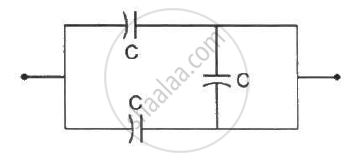
The equivalent capacitance of the combination shown in the figure is _________ .
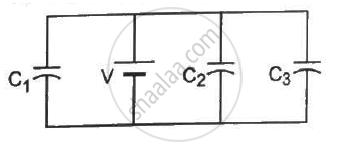
Find the charges on the three capacitors connected to a battery as shown in figure.
Take `C_1 = 2.0 uF , C_2 = 4.0 uF , C_3 = 6.0 uF and V` = 12 volts.
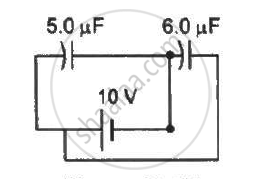
Find the charge supplied by the battery in the arrangement shown in figure.
A cylindrical capacitor is constructed using two coaxial cylinders of the same length 10 cm and of radii 2 mm and 4 mm. (a) Calculate the capacitance. (b) Another capacitor of the same length is constructed with cylinders of radii 4 mm and 8 mm. Calculate the capacitance.
The two square faces of a rectangular dielectric slab (dielectric constant 4⋅0) of dimensions 20 cm × 20 cm × 1⋅0 mm are metal-coated. Find the capacitance between the coated surfaces.
Obtain an expression for equivalent capacitance when three capacitors C1, C2 and C3 are connected in series.
Explain in detail the effect of a dielectric placed in a parallel plate capacitor.
Derive the expression for resultant capacitance, when the capacitor is connected in series.
Derive the expression for resultant capacitance, when the capacitor is connected in parallel.
The capacitance of a parallel plate capacitor is 60 µF. If the distance between the plates is tripled and area doubled then new capacitance will be ______.
Between the plates of parallel plate condenser there is 1 mm thick medium shoot of dielectric constant 4. It is charged at 100 volt. The electric field in volt/meter between the plates of capacitor is ______.
A leaky parallel plate capacitor is filled completely with a material having dielectric constant K = 5 and electric conductivity σ = 7.4 × 10⁻¹² Ω-1 m-1. If the charge on the plate at the instant t = 0 is q = 8.85 µC, then the leakage current at the instant t = 12 s is ______ × 10-1 µA.
A capacitor of capacity 2 µF is charged to a potential difference of 12 V. It is then connected across an inductor of inductance 0.6 mH. The current in the circuit at a time when the potential difference across the capacitor is 6.0 V is ______ × 10-1A.
Eight drops of mercury of equal radius and possessing equal charge combine to form a big drop. The capacitance of bigger drop as compared to each small drop is ______.
For the same potential difference, what does a larger capacitance mean?
For a given capacitor, what fixes its capacitance?
