Advertisements
Advertisements
प्रश्न
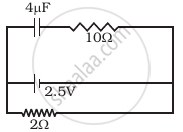
A capacitor of 4 µ F is connected as shown in the circuit (Figure). The internal resistance of the battery is 0.5 Ω. The amount of charge on the capacitor plates will be ______.
विकल्प
0
4 µ C
16 µ C
8 µ C
Advertisements
उत्तर
A capacitor of 4 µ F is connected as shown in the circuit (Figure). The internal resistance of the battery is 0.5 Ω. The amount of charge on the capacitor plates will be 8 µ C.
Explanation:
A capacitor offers zero resistance in a circuit when it is uncharged, i.e., it can be assumed as short-circuited and it offers infinite resistance when it is fully charged.
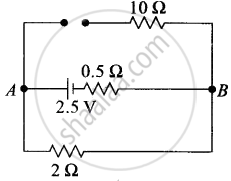
At steady state
At steady state the capacitor offers infinite resistance in the DC circuit and acts as the open circuit as shown in the figure, therefore no current flows through the capacitor and 10 Ω resistance, leaving zero potential difference across 10 Ω resistance. Hence potential difference across capacitors will be the potential difference across A and B.
The potential difference across lower and middle branches of the circuit is equal to the potential difference across the capacitor of upper branch of circuit.
Current flows through 2 Ω resistance from left to right, is given by I = v/R + r = 1A.The potential difference across 2 Ω resistance, V = IR = 1 × 2 = 2V Hence potential difference across capacitors is also 2V.
The charge on capacitor is q = CV = (2 μ F) × 2V = 8 μ C.
APPEARS IN
संबंधित प्रश्न
When an AC source is connected to an ideal capacitor, show that the average power supplied by the source over a complete cycle is zero
A capacitor of capacitance C is charged fully by connecting it to a battery of emf E. It is then disconnected from the battery. If the separation between the plates of the capacitor is now doubled, how will the following change?
(i) charge stored by the capacitor.
(ii) Field strength between the plates.
(iii) Energy stored by the capacitor.
Justify your answer in each case.
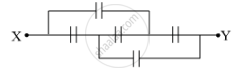
Find the equivalent capacitance of the network shown in the figure, when each capacitor is of 1 μF. When the ends X and Y are connected to a 6 V battery, find out (i) the charge and (ii) the energy stored in the network.
(i) Find equivalent capacitance between A and B in the combination given below. Each capacitor is of 2 µF capacitance.
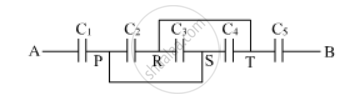
(ii) If a dc source of 7 V is connected across AB, how much charge is drawn from the source and what is the energy stored in the network?
Two identical capacitors of 12 pF each are connected in series across a battery of 50 V. How much electrostatic energy is stored in the combination? If these were connected in parallel across the same battery, how much energy will be stored in the combination now?
Also find the charge drawn from the battery in each case.
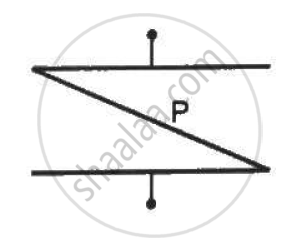
A thin metal plate P is inserted between the plates of a parallel-plate capacitor of capacitance C in such a way that its edges touch the two plates . The capacitance now becomes _________ .
The capacitance of a capacitor does not depend on
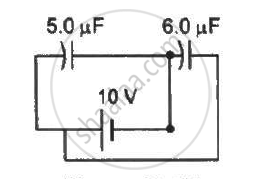
Find the charge appearing on each of the three capacitors shown in figure .
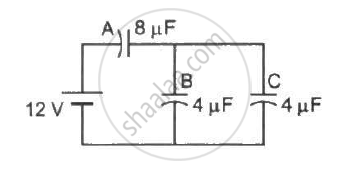
Find the charge supplied by the battery in the arrangement shown in figure.
It is required to construct a 10 µF capacitor which can be connected across a 200 V battery. Capacitors of capacitance 10 µF are available but they can withstand only 50 V. Design a combination which can yield the desired result.
Find the capacitances of the capacitors shown in figure . The plate area is Aand the separation between the plates is d. Different dielectric slabs in a particular part of the figure are of the same thickness and the entire gap between the plates is filled with the dielectric slabs.
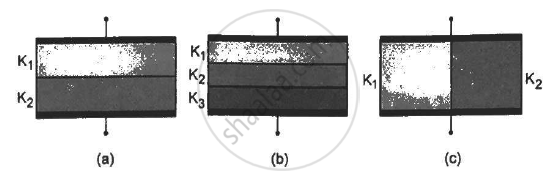
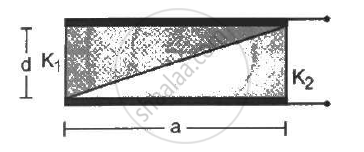
A capacitor is formed by two square metal-plates of edge a, separated by a distance d. Dielectrics of dielectric constant K1 and K2 are filled in the gap as shown in figure . Find the capacitance.
If the voltage applied on a capacitor is increased from V to 2V, choose the correct conclusion.
Define ‘capacitance’. Give its unit.
Three capacitors 2µF, 3µF, and 6µF are joined in series with each other. The equivalent capacitance is ____________.
Calculate equivalent capacitance of the circuit shown in the Figure given below:

Two spherical conductors of capacities 4 µF and 3 µF are charged to same potential having radii 4 cm and 3 cm respectively. If ‘σ1’ and ‘σ2’ represent surface density of charge on respective conductors then ______.
