Advertisements
Advertisements
Question
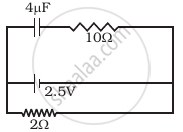
A capacitor of 4 µ F is connected as shown in the circuit (Figure). The internal resistance of the battery is 0.5 Ω. The amount of charge on the capacitor plates will be ______.
Options
0
4 µ C
16 µ C
8 µ C
Advertisements
Solution
A capacitor of 4 µ F is connected as shown in the circuit (Figure). The internal resistance of the battery is 0.5 Ω. The amount of charge on the capacitor plates will be 8 µ C.
Explanation:
A capacitor offers zero resistance in a circuit when it is uncharged, i.e., it can be assumed as short-circuited and it offers infinite resistance when it is fully charged.
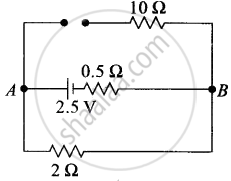
At steady state
At steady state the capacitor offers infinite resistance in the DC circuit and acts as the open circuit as shown in the figure, therefore no current flows through the capacitor and 10 Ω resistance, leaving zero potential difference across 10 Ω resistance. Hence potential difference across capacitors will be the potential difference across A and B.
The potential difference across lower and middle branches of the circuit is equal to the potential difference across the capacitor of upper branch of circuit.
Current flows through 2 Ω resistance from left to right, is given by I = v/R + r = 1A.The potential difference across 2 Ω resistance, V = IR = 1 × 2 = 2V Hence potential difference across capacitors is also 2V.
The charge on capacitor is q = CV = (2 μ F) × 2V = 8 μ C.
APPEARS IN
RELATED QUESTIONS
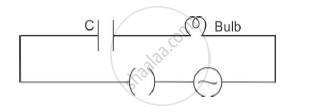
A bulb is connected in series with a variable capacitor and an AC source as shown. What happens to the brightness of the bulb when the key is plugged in and capacitance of the capacitor is gradually reduced?
Take `C_1 = 4.0 "uF" and C_2 = 6.0 "uF"` in figure . Calculate the equivalent capacitance of the combination between the points indicated.
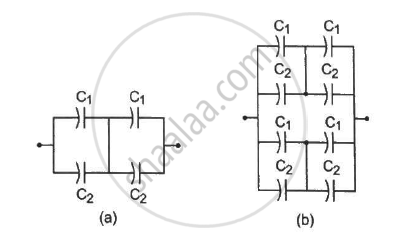
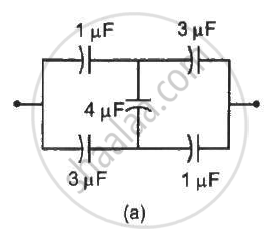
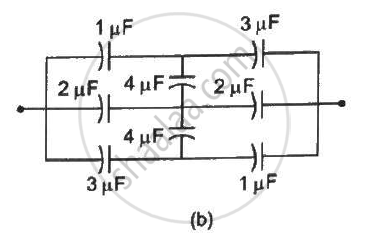
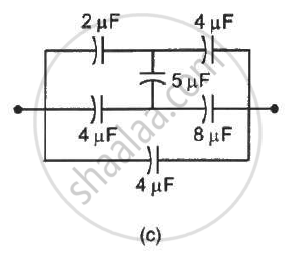
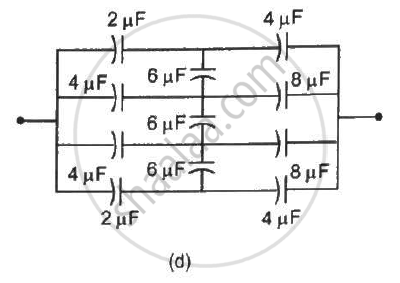
Find the equivalent capacitances of the combinations shown in figure between the indicated points.
A 5⋅0 µF capacitor is charged to 12 V. The positive plate of this capacitor is now connected to the negative terminal of a 12 V battery and vice versa. Calculate the heat developed in the connecting wires.
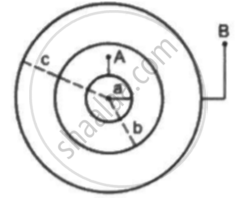
Consider an assembly of three conducting concentric spherical shell of radii a, b and c as shown in figure Find the capacitance of the assembly between the points Aand B.
An air-filled parallel-plate capacitor is to be constructed which can store 12 µC of charge when operated at 1200 V. What can be the minimum plate area of the capacitor? The dielectric strength of air is `3 xx 10^6 "Vm"^-1`
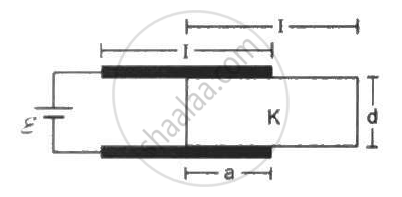
Consider the situation shown in figure. The plates of the capacitor have plate area A and are clamped in the laboratory. The dielectric slab is released from rest with a length a inside the capacitor. Neglecting any effect of friction or gravity, show that the slab will execute periodic motion and find its time period.
You are provided with 8 μF capacitors. Show with the help of a diagram how you will arrange minimum number of them to get a resultant capacitance of 20 μF.
Define ‘capacitance’. Give its unit.
Derive the expression for resultant capacitance, when the capacitor is connected in series.
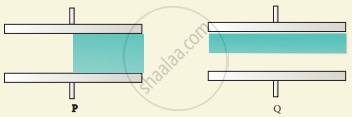
Capacitors P and Q have identical cross-sectional areas A and separation d. The space between the capacitors is filled with a dielectric of dielectric constant Er as shown in the figure. Calculate the capacitance of capacitors P and Q.
When air is replaced by a dielectric medium of constant K, the maximum force of attraction between two charges separated by a distance ______.
The radius of a sphere of capacity 1 microfarad in the air is ______
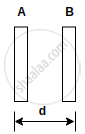
Two plates A and B of a parallel plate capacitor are arranged in such a way, that the area of each plate is S = 5 × 10⁻³ m 2 and distance between them is d = 8.85 mm. Plate A has a positive charge q1 = 10-10 C and Plate B has charge q2 = + 2 × 10⁻¹⁰ C. Then the charge induced on the plate B due to the plate A be - (....... × 10-11 )C
A capacitor of capacity 2 µF is charged to a potential difference of 12 V. It is then connected across an inductor of inductance 0.6 mH. The current in the circuit at a time when the potential difference across the capacitor is 6.0 V is ______ × 10-1A.
Calculate equivalent capacitance of the circuit shown in the Figure given below:

The plates of a parallel plate capacitor are separated by d. Two slabs of different dielectric constant K1 and K2 with thickness `3/8 d and d/2`, respectively, are inserted in the capacitor. Due to this, the capacitance becomes two times larger than when there is nothing between the plates. If K1 = 1.25 K, the value of K1 is:
Which statement lists the factors on which capacitance depends?
