Advertisements
Advertisements
Question
The variation of inductive reactance (XL) of an inductor with the frequency (f) of the ac source of 100 V and variable frequency is shown in fig.
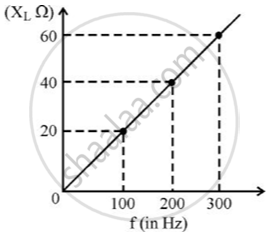
- Calculate the self-inductance of the inductor.
- When this inductor is used in series with a capacitor of unknown value and a resistor of 10 Ω at 300 s–1, maximum power dissipation occurs in the circuit. Calculate the capacitance of the capacitor.
Advertisements
Solution 1
i. We know that XL = ωL and ω = 2π f
Where,
f = frequency in Hz
So, L = `X_L/(2 pi f)`
= `(20)/(2 pi(100))`
= `(40)/(2pi (200))`
= `(60)/(2pi(300))`
= 31.84 × 10⁻³
≈ 32 mH
ii. We know that power dissipation is maximum when,
XL = XC
⇒ ωL = `1/(omegaC)`
⇒ `C = 1/(omega^2L)`
⇒ C = `1/(4 pi^2 f^2 L)`
= `1/(4 xx 3.14 xx 3.14 xx 300 xx 300 xx 32 xx 10^-3)`
= 8.8 μF
Solution 2
i. Given: From graph f = 100 Hz
XL = 20 Ω
Inductive reactance (XL) = 2π f L
So,
L = `X_L/(2 pi f)`
= `(20)/(2 pi xx 100)`
= 0.032 H
= 32 mH
ii. Given: f = 300 s−1
L = 0.032H
We know that power dissipation is maximum when,
2π f L = `1/(2 pi f C)`
2π × 300 × 0.032 = `1/(2 pi xx 300 xx C)`
∴ C = 8.8 × 10⁻⁶ F
= 8.8 μF
RELATED QUESTIONS
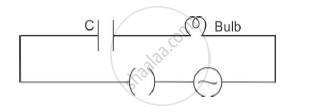
A bulb is connected in series with a variable capacitor and an AC source as shown. What happens to the brightness of the bulb when the key is plugged in and capacitance of the capacitor is gradually reduced?
Two identical capacitors of 12 pF each are connected in series across a battery of 50 V. How much electrostatic energy is stored in the combination? If these were connected in parallel across the same battery, how much energy will be stored in the combination now?
Also find the charge drawn from the battery in each case.
The plates of a parallel-plate capacitor are made of circular discs of radii 5⋅0 cm each. If the separation between the plates is 1⋅0 mm, what is the capacitance?
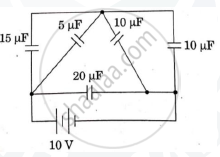
The figure show a network of five capacitors connected to a 10V battery. Calculate the charge acquired by the 5μF capacitor.
The work done in placing a charge of 8 × 10–18 coulomb on a condenser of capacity 100 micro-farad is ______.
When air is replaced by a dielectric medium of constant K, the maximum force of attraction between two charges separated by a distance ______.
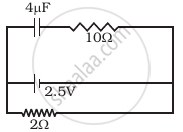
A capacitor of 4 µ F is connected as shown in the circuit (Figure). The internal resistance of the battery is 0.5 Ω. The amount of charge on the capacitor plates will be ______.
A leaky parallel plate capacitor is filled completely with a material having dielectric constant K = 5 and electric conductivity σ = 7.4 × 10⁻¹² Ω-1 m-1. If the charge on the plate at the instant t = 0 is q = 8.85 µC, then the leakage current at the instant t = 12 s is ______ × 10-1 µA.
Calculate equivalent capacitance of the circuit shown in the Figure given below:

In a series combination, which quantity is the same on each capacitor?
