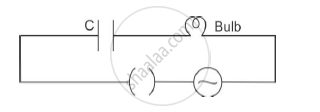
A Bulb is Connected in Series with a Variable Capacitor and an Ac Source as Shown. What Happens to the Brightness of the Bulb When the Key is Plugged in and Capacitance of the Capacitor is Gradually Reduced?
Advertisements
Question
A bulb is connected in series with a variable capacitor and an AC source as shown. What happens to the brightness of the bulb when the key is plugged in and capacitance of the capacitor is gradually reduced?
Advertisements
Solution
The capacitance of the capacitor is gradually reduced. Therefore, the capacitive reactance `X_c=1/(2pifC)` increases.
Therefore, essentially, the overall resistance of the circuit increases. This causes a reduction in the amount of current flowing through the circuit. Therefore, the brightness of the bulb reduces
APPEARS IN
RELATED QUESTIONS
A capacitor of capacitance ‘C’ is charged to ‘V’ volts by a battery. After some time the battery is disconnected and the distance between the plates is doubled. Now a slab of dielectric constant, 1 < k < 2, is introduced to fill the space between the plates. How will the following be affected? (a) The electric field between the plates of the capacitor Justify your answer by writing the necessary expressions.
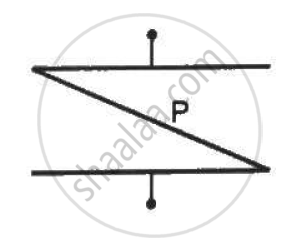
A thin metal plate P is inserted between the plates of a parallel-plate capacitor of capacitance C in such a way that its edges touch the two plates . The capacitance now becomes _________ .
Two metal spheres of capacitance C1 and C2 carry some charges. They are put in contact and then separated. The final charges Q1 and Q2 on them will satisfy
A parallel-plate capacitor has plate area 25⋅0 cm2 and a separation of 2⋅00 mm between the plates. The capacitor is connected to a battery of 12⋅0 V. (a) Find the charge on the capacitor. (b) The plate separation is decreased to 1⋅00 mm. Find the extra charge given by the battery to the positive plate.
It is required to construct a 10 µF capacitor which can be connected across a 200 V battery. Capacitors of capacitance 10 µF are available but they can withstand only 50 V. Design a combination which can yield the desired result.
Can the potential function have a maximum or minimum in free space?
A capacitor of capacity 2 µF is charged to a potential difference of 12 V. It is then connected across an inductor of inductance 0.6 mH. The current in the circuit at a time when the potential difference across the capacitor is 6.0 V is ______ × 10-1A.
Which combination has charge as its constant quantity and potential difference as its variable quantity?
In a parallel combination, which statement describes the charges on the capacitors?
