Advertisements
Advertisements
Question
Two metal spheres of capacitance C1 and C2 carry some charges. They are put in contact and then separated. The final charges Q1 and Q2 on them will satisfy
Options
`Q_1/Q_2< C_1/C_2`
`Q_1/Q_2 = C_1/C_2`
`Q_1/Q_2 > C_1/C_2`
`Q_1/Q_2 = C_2/C_1`
Advertisements
Solution
`Q_1/Q_2 = C_1/C_2`
When the spheres are connected, charges flow between them until they both acquire the same common potential V.
The final charges on the spheres are given by
Q1 = C1V and Q2 = C2V
`therefore Q_1/Q_2 = (C_1V)/(C_2V) = C_1/C_2`
APPEARS IN
RELATED QUESTIONS
Define capacitor reactance. Write its S.I units.
A spherical capacitor consists of two concentric spherical conductors, held in position by suitable insulating supports. Show that the capacitance of a spherical capacitor is given by
C = `(4piin_0"r"_1"r"_2)/("r"_1 - "r"_2)`
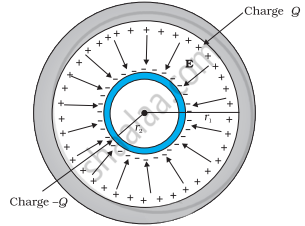
where r1 and r2 are the radii of outer and inner spheres, respectively.
A capacitor has capacitance C. Is this information sufficient to know what maximum charge the capacitor can contain? If yes, what is this charges? If no, what other information is needed?
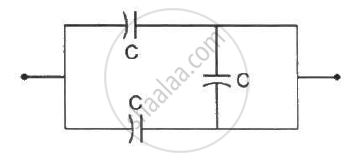
The equivalent capacitance of the combination shown in the figure is _________ .
The capacitance of a capacitor does not depend on
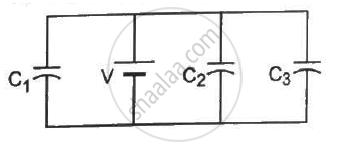
Find the charges on the three capacitors connected to a battery as shown in figure.
Take `C_1 = 2.0 uF , C_2 = 4.0 uF , C_3 = 6.0 uF and V` = 12 volts.
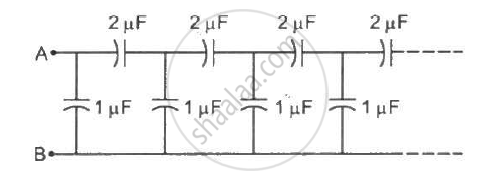
Find the equivalent capacitance of the infinite ladder shown in figure between the points A and B.
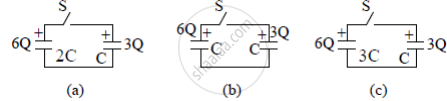
Three circuits, each consisting of a switch 'S' and two capacitors, are initially charged, as shown in the figure. After the switch has been closed, in which circuit will the charge on the left-hand capacitor
(i) increase,
(ii) decrease, and
(iii) remains the same? Give reasons.
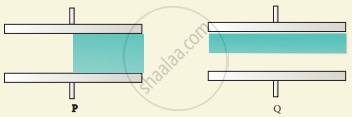
Capacitors P and Q have identical cross-sectional areas A and separation d. The space between the capacitors is filled with a dielectric of dielectric constant Er as shown in the figure. Calculate the capacitance of capacitors P and Q.
Three capacitors 2µF, 3µF, and 6µF are joined in series with each other. The equivalent capacitance is ____________.
Two similar conducting spheres having charge+ q and -q are placed at 'd' seperation from each other in air. The radius of each ball is r and the separation between their centre is d (d >> r). Calculate the capacitance of the two ball system ______.

For changing the capacitance of a given parallel plate capacitor, a dielectric material of dielectric constant K is used, which has the same area as the plates of the capacitor.
The thickness of the dielectric slab is `3/4`d, where 'd' is the separation between the plate of the parallel plate capacitor.
The new capacitance (C') in terms of the original capacitance (C0) is given by the following relation:
A 5µF capacitor is charged fully by a 220 V supply. It is then disconnected from the supply and is connected in series to another uncharged 2.5 µF capacitor If the energy change during the charge redistribution is `"X"/100`J then value of X to the 100 nearest integer is ______.
For the same potential difference, what does a larger capacitance mean?
Which set lists the factors on which capacitance depends?
What is the practical purpose of a series combination of capacitors?
