Advertisements
Advertisements
Question
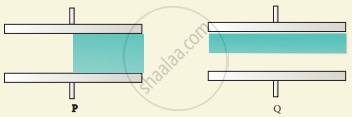
Capacitors P and Q have identical cross-sectional areas A and separation d. The space between the capacitors is filled with a dielectric of dielectric constant Er as shown in the figure. Calculate the capacitance of capacitors P and Q.
Advertisements
Solution
- The arrangement can be supposed to be a parallel combination of two capacitors each with plate area A/2 and separation. d. Total capacitance `"C"_"p" = "C"_"air" + "C"_"dielectric"`
`= (epsilon_0("A"//2))/"d" + (epsilon_0("A"//2)epsilon"r")/"d"`
`"C"_"p" = (epsilon_0"A")/"2d" (1 + epsilon_"r")` - The arrangement can be supposed to be a series combination of two capacitors, each with plate area A and separation d/2.
Total capacitance CQ = `("C"_1"C"_2)/("C"_1 + "C"_2)`
`= ((2epsilon_0"A")/"d" xx (2epsilon_"r"epsilon_0"A")/"d")/((2epsilon_0"A")/"d" + (2epsilon_"r"epsilon_0"A")/"d")`
`= (4epsilon_"r" ((epsilon_0"A")/"d")^2)/((2epsilon_0"A")/"d" (1 + epsilon_"r"))`
`= (2epsilon_"r" (epsilon_0"A")/"d")/(1 + epsilon_"r")`
`"C"_"Q" = (2epsilon_0"A")/"d" (epsilon_"r"/(1 + epsilon_"r"))`
APPEARS IN
RELATED QUESTIONS
A capacitor of capacitance ‘C’ is being charged by connecting it across a dc source along with an ammeter. Will the ammeter show a momentary deflection during the process of charging? If so, how would you explain this momentary deflection and the resulting continuity of current in the circuit? Write the expression for the current inside the capacitor.
Following operations can be performed on a capacitor:
X − connect the capacitor to a battery of emf ε.
Y − disconnect the battery.
Z − reconnect the battery with polarity reversed.
W − insert a dielectric slab in the capacitor.
(a) In XYZ (perform X, then Y, then Z) the stored electric energy remains unchanged and no thermal energy is developed.
(b) The charge appearing on the capacitor is greater after the action XWY than after the action XYZ.
(c) The electric energy stored in the capacitor is greater after the action WXY than after the action XYW.
(d) The electric field in the capacitor after the action XW is the same as that after WX.
The plates of a parallel-plate capacitor are made of circular discs of radii 5⋅0 cm each. If the separation between the plates is 1⋅0 mm, what is the capacitance?
Three capacitors having capacitances 20 µF, 30 µF and 40 µF are connected in series with a 12 V battery. Find the charge on each of the capacitors. How much work has been done by the battery in charging the capacitors?
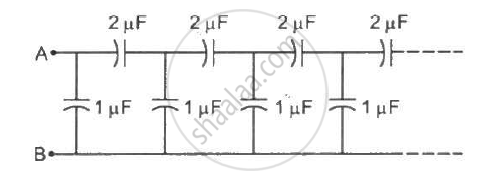
Find the equivalent capacitance of the infinite ladder shown in figure between the points A and B.
The two square faces of a rectangular dielectric slab (dielectric constant 4⋅0) of dimensions 20 cm × 20 cm × 1⋅0 mm are metal-coated. Find the capacitance between the coated surfaces.
A parallel-plate capacitor of capacitance 5 µF is connected to a battery of emf 6 V. The separation between the plates is 2 mm. (a) Find the charge on the positive plate. (b) Find the electric field between the plates. (c) A dielectric slab of thickness 1 mm and dielectric constant 5 is inserted into the gap to occupy the lower half of it. Find the capacitance of the new combination. (d) How much charge has flown through the battery after the slab is inserted?
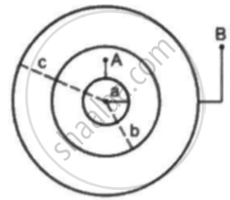
Suppose the space between the two inner shells is filled with a dielectric of dielectric constant K. Find the capacitance of the system between A and B.
A capacitor is charged by a battery. The battery is removed and another identical uncharged capacitor is connected in parallel. The total electrostatic energy of resulting system ______.
