Advertisements
Advertisements
प्रश्न
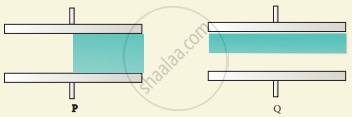
Capacitors P and Q have identical cross-sectional areas A and separation d. The space between the capacitors is filled with a dielectric of dielectric constant Er as shown in the figure. Calculate the capacitance of capacitors P and Q.
Advertisements
उत्तर
- The arrangement can be supposed to be a parallel combination of two capacitors each with plate area A/2 and separation. d. Total capacitance `"C"_"p" = "C"_"air" + "C"_"dielectric"`
`= (epsilon_0("A"//2))/"d" + (epsilon_0("A"//2)epsilon"r")/"d"`
`"C"_"p" = (epsilon_0"A")/"2d" (1 + epsilon_"r")` - The arrangement can be supposed to be a series combination of two capacitors, each with plate area A and separation d/2.
Total capacitance CQ = `("C"_1"C"_2)/("C"_1 + "C"_2)`
`= ((2epsilon_0"A")/"d" xx (2epsilon_"r"epsilon_0"A")/"d")/((2epsilon_0"A")/"d" + (2epsilon_"r"epsilon_0"A")/"d")`
`= (4epsilon_"r" ((epsilon_0"A")/"d")^2)/((2epsilon_0"A")/"d" (1 + epsilon_"r"))`
`= (2epsilon_"r" (epsilon_0"A")/"d")/(1 + epsilon_"r")`
`"C"_"Q" = (2epsilon_0"A")/"d" (epsilon_"r"/(1 + epsilon_"r"))`
APPEARS IN
संबंधित प्रश्न
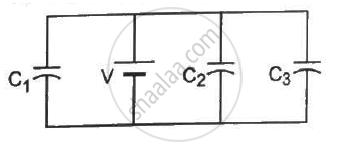
Find the charges on the three capacitors connected to a battery as shown in figure.
Take `C_1 = 2.0 uF , C_2 = 4.0 uF , C_3 = 6.0 uF and V` = 12 volts.
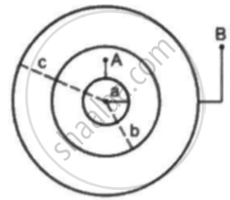
Suppose the space between the two inner shells is filled with a dielectric of dielectric constant K. Find the capacitance of the system between A and B.
A parallel-plate capacitor with the plate area 100 cm2 and the separation between the plates 1⋅0 cm is connected across a battery of emf 24 volts. Find the force of attraction between the plates.
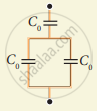
Calculate the resultant capacitances for each of the following combinations of capacitors.
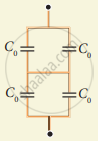
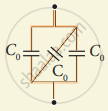
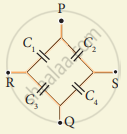
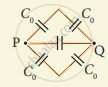
Between the plates of parallel plate condenser there is 1 mm thick medium shoot of dielectric constant 4. It is charged at 100 volt. The electric field in volt/meter between the plates of capacitor is ______.
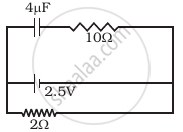
A capacitor of 4 µ F is connected as shown in the circuit (Figure). The internal resistance of the battery is 0.5 Ω. The amount of charge on the capacitor plates will be ______.
Consider two conducting spheres of radii R1 and R2 with R1 > R2. If the two are at the same potential, the larger sphere has more charge than the smaller sphere. State whether the charge density of the smaller sphere is more or less than that of the larger one.
For changing the capacitance of a given parallel plate capacitor, a dielectric material of dielectric constant K is used, which has the same area as the plates of the capacitor.
The thickness of the dielectric slab is `3/4`d, where 'd' is the separation between the plate of the parallel plate capacitor.
The new capacitance (C') in terms of the original capacitance (C0) is given by the following relation:
A leaky parallel plate capacitor is filled completely with a material having dielectric constant K = 5 and electric conductivity σ = 7.4 × 10⁻¹² Ω-1 m-1. If the charge on the plate at the instant t = 0 is q = 8.85 µC, then the leakage current at the instant t = 12 s is ______ × 10-1 µA.
For the same potential difference, what does a larger capacitance mean?
